Understanding Supervised and Unsupervised Learning
Now, we will examine the major distinction between supervised and unsupervised learning, the ways and purposes of their usage, their advantages, and how you can achieve mastery and become a professional data scientist.


Understanding Supervised and Unsupervised Learning
E N D
Presentation Transcript
Understanding Supervised and Unsupervised Learning Introduction: In a relatively short period, Artificial Intelligence (AI) and Machine Learning (ML) are transforming various industries. ML algorithms can be used to generate personalized shopping suggestions, detect fraud, and make multiple other data-driven decisions, making modern data-driven decision-making processes central. Nonetheless, both in supervised and unsupervised learning, this knowledge is one of the most essential foundations of a future data scientist. In case you are a person who wants to develop a solid foundation in ML or learn how these methods vary when used in practice, taking the best data science course in Bangalore could become a guiding experience. Now, we will examine the major distinction between supervised and unsupervised learning, the ways and purposes of their usage, their advantages, and how you can achieve mastery and become a professional data scientist. 1. Understanding the Basics: What Is Supervised Learning? Supervised learning is a learning algorithm of a machine learning algorithm in which a model is trained using labeled data. Labeled data refers to data that has been tagged with a specific output. That is, the algorithm learns with input-output pairs, representing given correct output information. It is performed through the provision of feed samples that consist of the features (input variables) and the labels (target outcomes) to the algorithm. The model uses this data to learn patterns and relationships, which it uses to make us some data that has not been seen before. Example: When you train a customer data model (data on income and age, spending habits, etc.) and label the customers as high-value or low-value customers, the model can then be used to predict the type of a new customer. Common Algorithms Used:
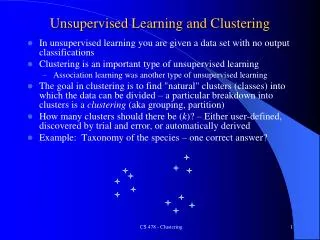
● Linear Regression ● Logistic Regression ● Decision Trees ● Random Forest ● Support Vector Machines (SVM) ● Neural Networks Principal Implication: Supervised learning pays attention to the prediction accuracy with the help of the labeled datasets. 2. What Is Unsupervised Learning? Unsupervised learning contrasts with supervised learning when the data is unlabeled. Outcomes or categories are not predetermined. Instead, the algorithm attempts to identify hidden patterns, groupings, or structures within the data. The clustering, dimensionality reduction, and pattern recognition are the primary areas of application of this kind of learning, where the aim is to identify insights about complex data sets, without any prior labeling being done. Example: Segmenting customers into categories based on purchasing behavior can be assisted by unmonitored learning in a retail business, even where the segments are not contained within some prior categories. Common Algorithms Used: ● K-Means Clustering ● Hierarchical Clustering ● Multi-Variable Analysis of Components (Principal Component Analysis) ● Association Rules ● Autoencoders Important Implication: Unsupervised learning assists in the process of discovering previously unknown patterns and structures without using labelled data. 3. Real-World Applications of Supervised Learning: Supervised learning is extensively applied in all industries because it can make accurate predictions and classifications. The following are some of the actual examples:
a. Healthcare The models based on machine learning can be trained using medical data with assigned labels to predict diseases, classify health images, and propose personalized treatment. b. Finance Supervised learning by banks has been applied in credit scoring, the prediction of who commits fraud, and loan approval. The algorithms are trained on historical transaction data to forecast future results. c. Marketing Supervised models are used for email filtering, advert targeting, and predicting churn of customers using historical data that has been labeled as such. d. Retail Supervised regression models are very important in price optimization and demand forecasting; they help in predicting future trends using past sales data. To become a master of these applications, the best data science course in Bangalore provides practical projects in such spheres as finance, healthcare, and e-commerce. The course will help you learn the abstract concept of how to solve business problems. 4. Real-World Applications of Unsupervised Learning: Unsupervised learning is a powerful tool when working with enormous unstructured datasets, in which labels are inaccessible or prohibitively expensive to acquire. Its ability to identify patterns and anomalies in such data is a testament to its versatility and importance in the field of data science. a. Customer Segmentation The algorithms of clustering are applied by entering the business with the goal of customer segmenting, where targeted marketing campaigns can be carried out. b. Anomaly Detection Unsupervised models identify anomalies in the systems - necessary in cybersecurity, network monitors, and detecting fraud cases. c. Recommendation Systems Online sites such as Netflix or Amazon rely on unsupervised learning to give recommendations on products or movies by determining similarities between users or products.
d. Statistics Graphing and Noise Cancellation. Dimensionality reduction, such as PCA, assists in the elimination of redundancy of information and data visualization. These algorithms of unsupervised learning can be applied with Python application libraries such as Scikit-learn, Tensorflow, and PyTorch by taking a comprehensive data science course in Bangalore. 5. Advantages and Limitations of Each Approach: Supervised Learning Supervision Pros: ● Gives accurate results when the data performance is labeled. ● Appropriate in terms of both classification and regression. ● Measurable and readily usable using metrics. Limitations: ● High quantities of labeled data are required. ● Labeling is time-consuming and costly. ● Poor skill to find out new patterns. Unmonitored Learning - Benefits: Operates on unlabeled data, which is cost and time-saving. Good at exploratory data analysis. Be in a position to discover concealed understanding and relations. Limitations: ● Hard to evaluate results ● Peril of forming spurious groups. ● May needs to be fine-tuned. Both methods are essential in modern AI workflows — and understanding when to use each is a key skill taught in advanced modules of the best data science course in Bangalore. Conclusion: Machine learning and artificial intelligence are based on supervised and unsupervised learning. Although the former aims at forecasting results based on labeled data, the latter reveals trends in unlabeled data, both of which cannot be done without the current data ecosystem.
No matter what position you want to take to work as a data analyst, machine learning engineer, or AI researcher, you will have to know these two learning paradigms. If you need to jump into the world of ML or want to be on the advanced level, it would be possible to meet the best data science course in Bangalore and receive the practical experience, be engaged in real projects, and make your own portfolio that could become popular in the modern competitive environment with technologies.