The Milky Way
The Milky Way Physical Astronomy Professor Lee Carkner Lecture 20 The Milky Way We can see the band of the Milky Way on a dark night Nature of galaxy not known until early 20 th century Basic structure Central dense bulge Young disk with spiral arms Old halo with dark matter Disk

The Milky Way
E N D
Presentation Transcript
The Milky Way Physical Astronomy Professor Lee Carkner Lecture 20
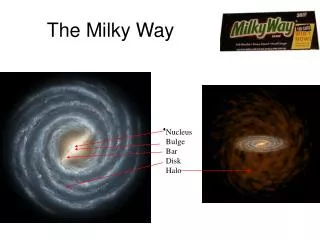
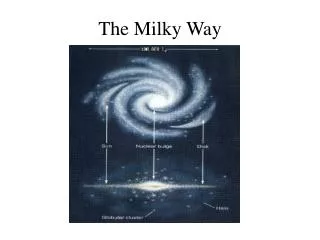
The Milky Way • We can see the band of the Milky Way on a dark night • Nature of galaxy not known until early 20th century • Basic structure • Central dense bulge • Young disk with spiral arms • Old halo with dark matter
Disk • Most visible area of the MW • Sun is ~8 kpc from center • Two components • Height ~ 350 pc • Site of current star formation • Thick disk of older stars • Fainter and has fewer stars (few % of thin disk)
Metallicity • We use metal abundance as a proxy for age • Normally use the iron to hydrogen ratio compared to the sun [Fe/H] = log [(NFe/NH)star / (NFe/NH)sun] • Range: • 0 (exactly like the sun) • Not perfectly reliable • Not completely mixed
Age of Disk • Thin disk has broad range of metallicities • -0.5 to 0.3 • -0.6 to -0.4 • Formed from episode of star formation between 10 and 11 Gya
Spiral Arms • Gas, dust, young stars, bright stars, blue stars all concentrated in arms • Hard to map in our galaxy • From via density waves • As clouds orbit the Milky Way, they get stuck in areas of greater density
The Bulge • The central part of the MW is a thickened bar-shaped bulge • Hard to see due to extinction • Due to several waves of star formation • Region within which ½ of the light is emitted
Halo • Above and below the disk are the globular clusters About 150 total • Metallicity around -0.8 • May be associated with thick disk • Or else would have broken up over the last ~12 Gyr
Rotation Curve • period of sun ~ 230 million years • Rotation speed should fall off with distance • Instead galaxy has flat rotation curve • Rotational velocity constant with increasing distance from center
Dark Matter • However, orbits of stars exterior to the sun indicate that there must be a total of about 1012 Msun • Dark matter is about 95% of total galactic mass • Cannot be dust, gas or stars
Mass to Light • Ratio of mass in solar masses to light in solar luminosities • For Milky Way ~ 60
Dark Matter Candidates • MACHOs • MAssive Compact Halo Objects • White dwarfs, neutron stars, black holes, red dwarfs, brown dwarfs • Should pass in front of other stars, momentarily brightening them • WIMPs • Very low probability of interaction • Should be able to detect in very large isolated detector arrays
Galactic Center • Galactic center is 8 kpc from the sun in the constellation of Sagittarius • Can find from distribution of halo globular clusters • Best data from radio, IR and X-ray (not visible) • stars are “isothermal”
Radio Observations • A complex series of thermal and non-thermal sources • At the center is a very bright, unresolved source, Sgr A* • Less than ~2 AU in size
X-ray Observations • Sgr A* corresponds to a bright X-ray source • Explosions of material must have occurred in the past
IR Observations • The K band at 2.2 mm is used to observe stars close to Sgr A* • Can use Kepler’s third law to find mass of Sgr A*
The Core • Sgr A* has a mass of 3.7X10⁶ Msun in a space less than 2 AU in size • Destroys near-by stars to provide mass for accretion disk and outflows • Black hole is fairly quiescent
Next Time • Read 25.1-25.4 • Homework: 24.2, 24.30, 24.33, 25.2b, 25.8a, 25.8b