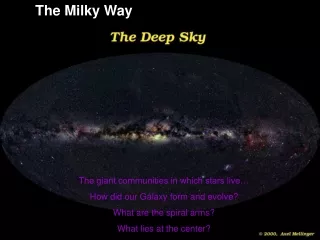
The Milky Way
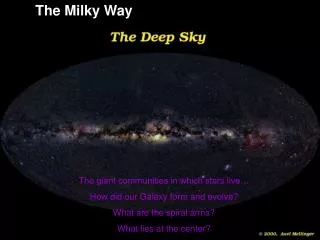
The Milky Way galaxy is a stunning band of light visible from Earth, inspiring its name. It boasts a mass of approximately 5.8 × 10^11 solar masses and spans about 100,000 light-years in diameter. At an astonishing age of 13.2 billion years, it features four major spiral arms. The Milky Way is part of the Local Group with the Andromeda Galaxy and many companions, moving at around 600 km/s. This overview delves into its size, environment, and fascinating cosmic metrics, shedding light on our galaxy's grandeur and complexity.


The Milky Way
E N D
Presentation Transcript
Sum up • Introduction: the Milky Way’s identity • View from Earth: a few explications • Size and mass • Age • Spiral arms • Environment • Velocity • Some order of magnitude
Introduction • The Milky Way galaxy is visible from Earth as a band of light in the night sky, and it is the appearance of this band of light which has inspired the name for our galaxy.
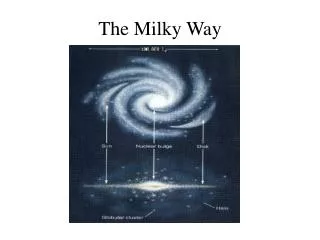
Size and mass • Mass: about 5.8×10^11 • Size: approximately 10×10^4 light years in diameter, and about 10×10^2 light years thick.
Age About 13.2×10^9 years
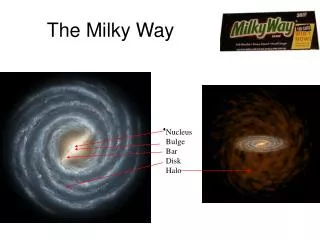
Spiral arms There are four major spiral arms in the Milky way.
Environment • The Milky Way and the Andromeda Galaxy are a binary system of giant spiral galaxies. Together with their companion galaxies they form the Local Group, a group of some 50 closely limited galaxies. Andromeda Galaxy
velocity • Many astronomers believe that the Milky Way is moving at approximately 600 km per second.
Some order of magnitude • 10^23 m: 10 million light years away from the Milky Way • 10^21 m: our galaxy, the Milky Way • 10^20 m: stars at the rim of the Milky Way galaxy • 10^19 m: stars in the Milky Way galaxy • 10^18 m: 100 light years from earth and nothing but stars • 10^13 m: our solar system • 10^9 m: the earth and the orbit of the moon
The end Our references: • Images: Google • Text: Wikipédia http://www.eso.org/public/outreach/press-rel/pr-2004/pr-20-04.html. Nwnw.gsfc.nasa.gov/-5k-