Exploring the Milky Way: Structure, Nebulae, and Galaxy Types
The Milky Way is a vast galaxy, visible as a glowing band of stars across the night sky, obscured in places by dust and gas. Its structure includes features such as the nuclear bulge, spiral arms filled with young stars, and a surrounding halo of older stars. Nebulae, the clouds of gas, can be classified into reflection, emission, and absorption types, each revealing a different aspect of stellar formation. Understanding the Milky Way helps us grasp the nature of galaxies, including types like elliptical, spiral, and irregular galaxies within clusters.

Exploring the Milky Way: Structure, Nebulae, and Galaxy Types
E N D
Presentation Transcript
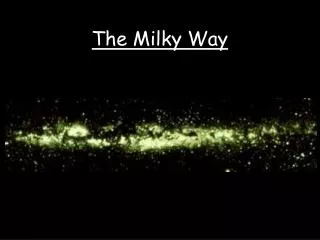
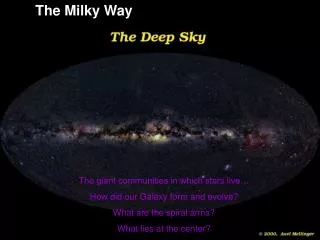
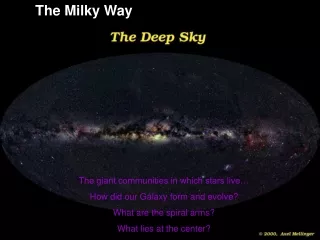
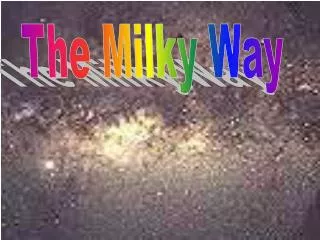
The Milky Way • Appears as a band of light stretching across the sky • There are dark regions along the band, giving the appearance of a lack of stars • This is caused by dust and gas obscuring the light of stars behind
The Milky Way • The gas and dust limits our view to about 6000 light years • Much of this gas and dust can be observed in the form of nebulae • A nebula is a cloud of gas seen in visible light • How the gas is seen depends on the stars around it
The Milky Way • Types of Nebulae • 1. Reflection Nebula: • this type of nebula reflects the light of the stars in and around it • it appears blue because the nearby stars are luminous, young main-sequence stars • Ex: the Pleides
The Milky Way • Types of Nebulae • 2. Emission Nebula • This type of nebula is caused by high energy radiation (UV) from nearby stars exciting the gas into emitting its own light • These regions are known as HII regions (hydrogen has been ionized
The Milky Way • Types of Nebulae • 3. Absorption Nebula • this type of nebula is made of cooler gas and dust • it doesn’t glow; it obscures our view of things behind • it appears as a dark silhouette
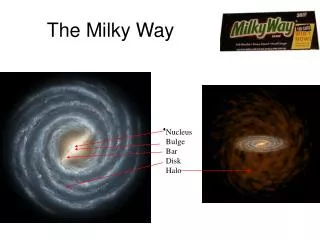
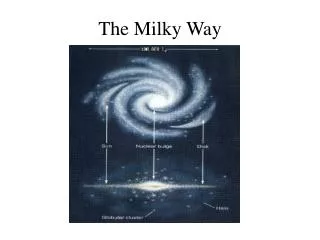
The Nuclear Bulge • Radius: 16,000 light years • Contains Population II stars • Older stars, K type stars • Generally free of gas and dust • Nucleus: 10 light years across • Studies indicate the presence of a massive non-stellar black hole
The Disk • Extends 50,000 light years beyond the central bulge • Forms spiral arms that contain a lot of gas and dust • Population I stars are found in the spiral arms • these are young O and B main-sequence stars • they are often found in open clusters • The Sun is about 2/3 of the way out from the center
The Disk • The disk is very thin • Its “thickness” is only about 2% of its width • Spiral structure has been determined through radio observations • Radio observations have shown how the spiral arms move around the center of the galaxy • It takes 250 million years for the Sun to make one orbit around the galactic center
The Halo • The halo completely surrounds the disk of the galaxy • It contains Population II stars • Most of the stars are found in globular clusters
The Galactic Corona • 200,000 - 300,000 ly beyond • Contains 5 - 10 times as much mass as the rest of the galaxy • Can only detect it through gravitational effects
Elliptical Galaxies • Most common type of galaxy, trillion solar masses; • Largest: 10 - 100 kpc across; these are very rare • Dwarf ellipticals are the most common • 2 - 3 million solar masses; 2000 pc across • Shape is based on optical appearance: • circular: E0 • most elongated: E7
Spiral Galaxies • Brighter & larger than ellipticals • 25,000 - 800,000 pc across • 109 - 1012 solar masses • 1/3 of all spirals are barred • Classified based on the size of nucleus & how tightly arms are wound
Irregular and Peculiar Galaxies • Irregular galaxies show no regular shape • Could be remnants of a collision • Ex: Large magellanic clouds • Peculiar galaxies are very rare • may look like a regular galaxy exploded • May be a result of a collision
Hubble Classification • Amount of interstellar gas and dust differs in each type of galaxy • Ellipticals have very little gas or dust; spirals have a lot • In spirals, amount of gas increases from Sa to Sc • In spirals, amount of star formation increases from Sa to Sc • O and B stars formed mostly in Sc, SBc, and Irr galaxies
Clusters of Galaxies • The Local Group: • Contains about 2 dozen of the nearest galaxies • 1 megaparsec in diameter • Distant Clusters • Contain 100’s to 1000’ of galaxies • Virgo Cluster: • Closest cluster to us; 20 Mpc distance, 2 Mpc across • Superclusters • Many clusters form a supercluster • There are 16 superclusters within 2 billion ly