Development of a Low Energy Hydrogen Sensor for Fire Detection and Safety Applications
This study presents a novel low-energy hydrogen sensor aimed at improving fire detection systems. Conducted at Humboldt University of Berlin, the research addresses the high energy consumption and cost of existing hydrogen sensors, which limit their use in battery-powered applications. The sensor features a unique micro-hotplate structure with a palladium-based field-effect mechanism, achieving low detection limits and rapid response times. Key findings include successful thermal reactivation, low power consumption, and effective alarm capabilities at lower explosion thresholds, highlighting its potential for integration with energy harvesting technologies.

Development of a Low Energy Hydrogen Sensor for Fire Detection and Safety Applications
E N D
Presentation Transcript
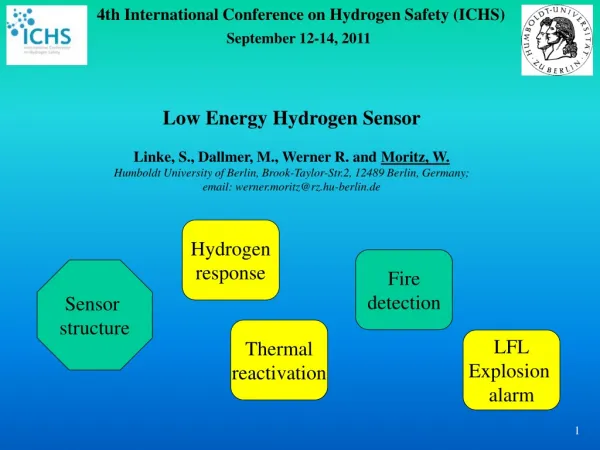
Low Energy Hydrogen SensorLinke, S., Dallmer, M., Werner R. and Moritz, W.Humboldt University of Berlin, Brook-Taylor-Str.2, 12489 Berlin, Germany;email: werner.moritz@rz.hu-berlin.de Hydrogen response Fire detection Sensor structure Thermal reactivation LFL Explosion alarm
Palladium Si3N4 SiO2 Si • Disadvantages of available • hydrogen sensors: • energy consumption too high for battery powered systems due to elevated working temperature • price to high for mass products • poor selectivity Sensor structure
Electrochemical mechanism ((different to Lundström type)) CV-measurement Palladium Si LaF3
Response of the Pd/LaF3/Si3N4/SiO2/Si field effect structure (solid line and left scale) to different concentrations of hydrogen (doted line and right scale) in synthetic air; room temperature; measurement 1 hour after preparation of the Pd layer
Heating and temperature measurement No method for fast surface temperature measurement 4-point measurement resistance of Pt 1 - Pt; 2 - LaF3; 3 - SiO2/Si3N4; 4 - n-Si; 5 - ohmic contact
Calculations of temperature distribution 1 s 10 W 10Ws LaF3 240 nm SiO2/Si3N4 80nm 10 ms 100W 1mWs 100ns 1000W 100mWS
Constant surface temperature Parameters of the electrical heating pulse used in Fig. above Max. current 8,4A Cur. dens. 2,8*107 Acm-2 Max. voltage 293 V Max. power 2365 W Total energy 1,82*10-3 J ((average 2x10⁻⁸ W)) TSi=0,025 K 500 activations simulating 2 years
Temperature distribution for different impulse duration Average power consumption 2x10⁻⁶ W Fast decay to room temperature
Low concentration range Hydrogen signal in air after thermal reactivation 136 mV/decade room temperature Limit of detection 500 ppb
A Fire Experiment in a Wooden House.......... T- Amamoto et al., Sensors and Actuators, B1 (1990) 226-230
Early state of Fire (smoldering) TF 2 wood on electrical heater
High concentration range LFL 4% (40 000 ppm) alarm level 1,6% Response time t90 (@8000 ppm)= 4 s 150 mV/dec
Stress test simulating 330 days of activations and mesurements all 330 measurements Day 2, 50, 150 and 300
Mechanism Oxygen sensor O2 + A* O2 (A*)(1) O2 (A*) + H2O + e-HO2 (A*) + OH- (2) OH- + (F*) OH-(F*) (3) Additional hydrogen action O2 (A*) + H2 H2O (A*) (4)
Conclusions • - room temperature hydrogen sensor in ppm range and for high concentration • thermal reactivation is possible • Low energy consumption for heating impuls • early fire detection • alarm at lower explosion level • Battery power application for long time • Combination with energy harvesting technology possible