Complex Inheritance
Complex Inheritance<br>

Complex Inheritance
E N D
Presentation Transcript
Unit 5 Complex Inheritance
Chromosome Structure • Chromosome– rod shaped structures made of DNA and proteins • Less tightly coiled DNA-proteincomplex – chromatin • DNA wrapped around histones –proteins that help maintain shape • Each half is called chromatid held together in middle by centromere
Chromosome Numbers • Sex Chromosomes – determine the sex of organismXX=Female XY=Male (If you have a Y, you’re a guy) • Autosomes – all other chromosomes • 23 pairs – 46 chromosomes • 23 identical copies from each parent • Both copies are called homologous chromosomes
Changes in chromosome numbers • Karyotype – photo of chromosomes • Extra chromosome, missing chromosomes, missing parts of chromosomes all result in disordersand diseases
Diploid vs Haploid • Diploid (2n) – contains two sets of chromosomes • Haploid (n) – contains one set of chromosomes • Gametes – sperm and egg cells • Sperm cell (n) + egg cell (n) = zygote (2n)
Meiosis • Cell division that halves the number of chromosomes when forming cells such as gametes (sex cells) • Reproduction of sex cells – sperm & egg • Four haploid (n) cells are produced • Crossing over can occur to increase genetic variation
Prophase 1 • Nuclear envelope disappears • Crossing-over occurs – when homologous chromosomes exchange genetic material
Metaphase 1 • Chromosomes move to center of cell
Anaphase 1 • Homologous chromosomes split and move to opposite ends
Telophase 1 • Nuclear envelope appears and spindle fibers disappears • Cytokinesis begins
Prophase II • Nuclear envelope disappears
Metaphase II • Chromosomes line up at the center
Anaphase II • Centromeres divide • Chromatids move to different ends of the cell
Telophase II • Nuclear envelope forms and spindle fibers disappear • Cytokinesis begins • Produces: 4 haploid cells
Mitosis Meiosis Both
Genetics • Passing of characteristics - Heredity • Gregor Mendel – “Father of Genetics” • Used green pea plants • Study of heredity – Genetics
Heredity Terms • Gregor Mendel – “Father of Genetics” • Alleles – refers to different versions of genes • Dominant – capital letter – if present, trait is expressed • Recessive – lower case letter – must have two to be expressed
Heredity Terms • True “pure” breed – only 1 type of allele • Homozygous (TT, tt) • Hybrids – two different types of alleles • Heterozygous (Tt) • Phenotype – physical trait • Genotype – genetic make up
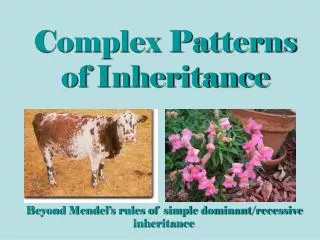
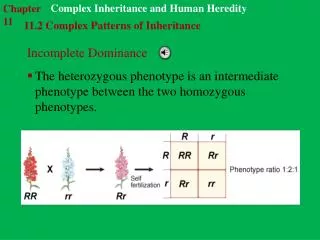
Complex Patterns of Inheritance • Incomplete Dominance • Heterzygous phenotype is an intermediate of dominant and recessive • Red+white=pink • Co-dominance • Both alleles are expressed in the heterozygous condition
Complex Patterns of Inheritance • Multiple Alleles • Blood groups in humans • A- & A+ • B- & B+ • AB- & AB+ • O- & O+ • Universal Donor • Universal Recipient
Complex Patterns of Inheritance • Sex-Linked Traits • Traits controlled by genes located on X chromosomes • More common in males than females • Red-Green Color Blindness • Hemophilia – blood clotting disorder
Pedigrees • Diagram that traces the inheritance of a trait through several generations