Une image / un lien ci-dessous est fourni (tel quel) pour télécharger la présentation
Politique de téléchargement : le contenu du site vous est fourni TEL QUEL pour votre information et votre usage personnel ; il ne peut être vendu, concédé sous licence ni partagé sur d’autres sites sans l’accord de son auteur.Le contenu vous est fourni TEL QUEL, pour votre information et votre usage personnel uniquement.Téléchargez la présentation en cliquant sur ce lien.Lors du téléchargement, si vous ne parvenez pas à télécharger une présentation, l’éditeur a peut-être supprimé le fichier de son serveur.Pendant le téléchargement, si vous ne parvenez pas à obtenir une présentation, le fichier a peut-être été supprimé par l’éditeur.
F I N
Plus de contenu associé
Transcription de la présentation
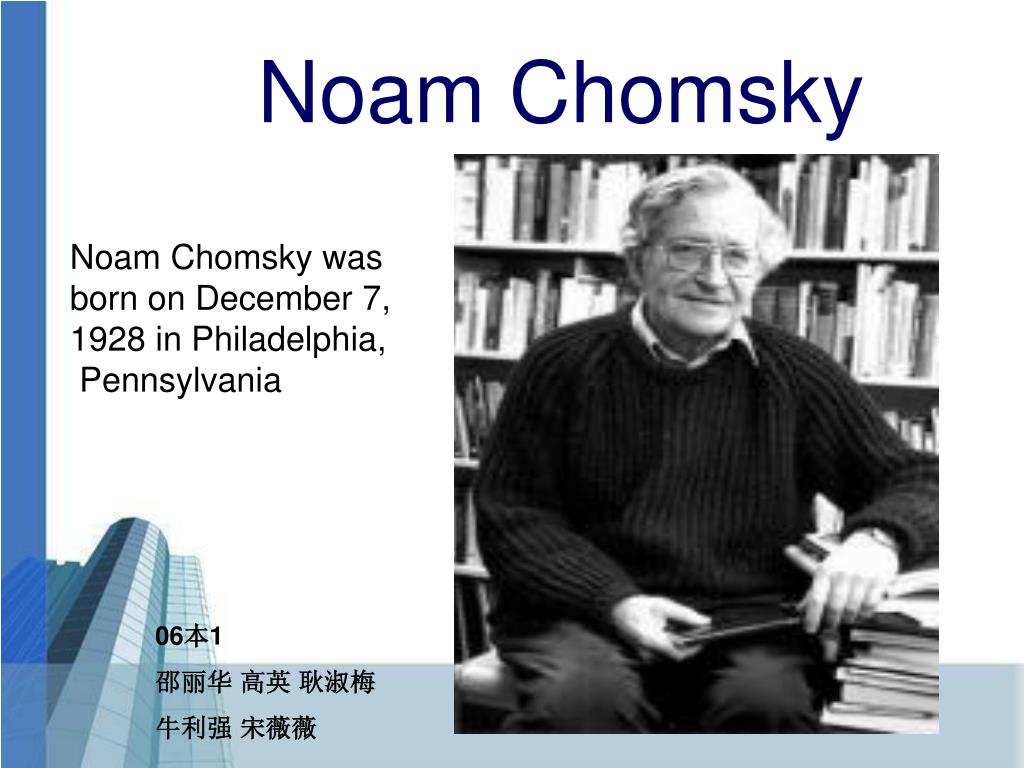
Noam Chomsky Noam Chomsky was born on December 7, 1928 in Philadelphia, Pennsylvania 06本1 邵丽华 高英 耿淑梅 牛利强 宋薇薇
Introduction Chomsky, Noam, in full AVRAM NOAM CHOMSKY (b. Dec. 7, 1928,Philadelphia, Pa., U.S.), American linguist and political activist who founded transformational generative grammar, an original and highly influential system of linguistic analysis. His undergraduate and graduate years were spent at the University of Pennsylvania where he received his PhD in linguistics in 1955. During the years 1951 to 1955, Chomsky was a Junior Fellow of the Harvard University Society of Fellows. While a Junior Fellow he completed his doctoral dissertation entitled, "Transformational Analysis." The major theoretical viewpoints of the dissertation appeared in the monograph Syntactic Structure, which was published in 1957. This formed part of a more extensive work, The Logical Structure of Linguistic Theory, circulated in mimeograph in 1955 and published in 1975.
Chomsky was introduced to the study of linguistics by his father, a Hebrew scholar who worked within the framework of historical linguistics. He studied under the linguist Zellig S. Harris at the University of Pennsylvania and earned bachelor's (1949) and master's (1951) degrees there. The early stages of Chomsky's theories of language appear in his University of Pennsylvania Ph.D. dissertation, "Transformational Analysis" (1955). After receiving his degree, he began teaching modern languages and linguistics at the Massachusetts Institute of Technology (MIT) in 1955. He became a full professor there in 1961 and was appointed Ferrari P. Ward professor of foreign languages and linguistics in 1966.
Works Chomsky's work virtually defined the methods of linguistic analysis used in the second half of the 20th century. Aspects of the Theory of Syntax (1965), Cartesian Linguistics (1966), The Sound Pattern of English (with Morris Halle, 1968), Language and Mind (1968; enlarged ed., 1972), The Logical Structure of Linguistic Theory (1975), and Reflections on Language (1975). Language and Responsibility (1979) discusses the relation of language and politics and the ramifications of generative grammar. Language and Problems of Knowledge (1988), further examine those subjects.
Chomsky also became well known for his opposition to the United States' involvement in the Vietnam War during the late1960s and early '70s. His books criticizing American foreign policy and the role played by giant corporations and the mass media include American Power and the New Mandarins (1969), Towards a New Cold War (1982), Pirates & Emperors (1986), On Power and Ideology (1987), Necessary Illusions: Thought Control in Democratic Societies (1989), and World Orders, Old and New (1994).
First language acquisition • Language was a creative act of the individual and that humans had an innate capacity for language,which by no means endowed by culture. -----Von Humboldt • The individual’s potential for language is universal. ------Chomsky
First language acquisition • Individual’s potential for acquiring any language • Competence (Chomsky) • Irrelevant to cultural differences ,nor race differences • A spontaneous process • From babyhood
First Language Acquisition (FLA):first Language acquisition refers to children’s development of their first language, that is, the native language of the community in which a child has been brought up (naturally and successfully).
Stages of first language acquisition In general, children begin uttering their first words sometimes during the second year of life. During the following 4 to 5 years, linguistic development occurs quite rapidly. ① the prelinguistic stage (babbling age) 3 months: /k/, /u/ 3-4 months: babbling speech like sounds 6 months: able to sit up; produce a number of different vowels and consonants (meaningless), deaf baby, baby born of non-speaking deaf parents also babble
② the one-word stage holophrastic sentences • 2 year-old: use one word to serve a naming function, to refer to familiar people, toys, pets, drinks and objects in the child’s environment, indicate certain actions and demands, or convey emotions. • Simple nouns and verbs • Very few functional words such as prep., art., and aux. verbs • Choose the most informative word that applies to the situation being commented upon • Overextension (underextension of reference): use the same word for things that have a similar appearance
③ the multiword stage • 2-3 year-old: the salient feature of the utterances at this stage ceases to be the number of words, but the variation in strings of lexical morphemes (telegraphic speech) • Lacking grammatical morphemes, but following the principles of sentence formation [make no word order errors at this stage] • 5 year-old: has an operating vocabulary of more than 2000 words
The classical theory Time:From1957-1965 Aim: to make linguistics a science. Work: syntactic structure Feature:(1)emphasis on generative ability of language (2)introduction of transformational rules (3)grammatical description regardless of meaning.
The classical theory • There kinds of grammar: finite state grammar, Phrase structure grammar, transformational grammar. • A finite state grammar is the simplest type of grammar with a finite amount of apparatus, can generate an infinite number of sentence.
The classical theory • Phrase structure grammar consists of phrase structure(ps) that formalize some of the traditional insights of constituent structure analysis. Phrase structure rules are as follows: • (1)S NP+VP • (2)VP Verb+NP • (3)NP NP(singular) • NP(plural) • (4)NP D+N • (5)NP(p) D+N+S
The classical theory • (6)D the • (7)N {man, ball, door, dog, book….} • (8)Verb Aux +V • (9)V {hit, take ,bite, eat…} • (10)Aux Tense (+M) (+have+en)(+be+ing) • (11)Tense Present • Past • (12)M {will, can, may, shall…}
The standard theory • Time :1965-1970 • Work :Aspects of syntax • Problems which lead to the standard theory: • (1)an ordinary sentence can be transformed at will,negated ,passived, with certain added or deleted, without restrictions. (2)his rules may generated ill-formed sentences as well as well-formed ones. for example, with the rules S NP+VP, and VP V+NP, there might be generated the following two: S S NP VP VP NP V NP V NP TV LUCY watch TV LUCY Watch
The standard theory • In his aspects of the theory of syntax, Chomsky says that a generative grammar should consist of three components: syntactic, phonological, andsemantic.
The standard theory • 这个时期乔姆斯基对第一理论时期的观点进行了修订,区分了深层结构和表层结构、语言能力与语言运用,形成了标准理论的理论模型,这个模型包含四个部分:基础规则、转换规则、语义规则、语音规则。其中基础规则包括短语结构规则和词库和词汇插入规则,由它们生成深层结构。转换规则包括移位、删略等转换; • 语义部分由语义知识、语义描写、语义表达式和语义规则组成。乔姆斯基主张语义完全由深层结构决定,转换不能改变语义。语音规则按照区别性特征(distinctive features)对语音的底层表现形式进行形式描写从而得出表层的语音特征
The extended standard theory • The problems that lead to the revision of standard theory:(1)the transformational rules are too powerful, for they can move or delect linguistic segments, keep the original meaning intact, and vary according to specific circumstances. • (2)the standard theory holds that derived nouns have the same semantic properties with their corresponding verbs .
Beavers build dams. • Dans are built by beavers. • Not many arrows hit the target. • Many arrows didn’t hit the target.
The extended standard theory • 1970年-1979年为“修正的扩充标准理论时期”,其主要作品有《关于动词名物化的一些看法》(1970)、《深层结构、表层结构及语义说明》(1971)和《转化的必要条件》(1973)、《关于形式与解释的论文集(1977)。 • 修正的扩充标准理论时期进一步修正了规则,提出了一些新的概念,如短语规则中用了X-杠(X-bar)表示,在转换规则中引入了“虚迹”(trace),最大的变化是把部分语义解释移到表层结构中。
The extended standard theory • Chomsky’s second revision involves the whole theorical framework, which can be illustrated by the following diagram: 基础部分 基础规则 深层结构 转换规则 表层结构 语音规则 语义规则 语音表达 逻辑形式表达
The Revised Extended Theory Government and binding is a theory of syntax in the tradition of transformational grammar developed principally by Chomsky in the 1980s.
格理论 1)结构格:由语境决定 例如:宾格 2)固有格 John gave Bill a book. 3)所有具有语音形式的NP必须有格 John thought that he left his bookon the table. John give a book to Bill.
minimalist program • 最简方案 minimalist program (me) (MP) 生成语言学思想的最新发展,强调语言学的目标是使有关语言的说明尽可能简洁和概括。所有的表征式和派生过程应尽可能经济,标准是提出的用来解释语言现象的设置数目应尽量少(“经济原则”)——这实际上是奥卡姆剃刀的具体应用。句子结构的表征中不应有任何羡余的或多余的成分:每个成分必须充当一个角色并得到解释(“完整解释原则”)。
Chomsky's influence in linguistics • The most important is that which develops a broad general critique of Chomsky's work and advances some sort of alternative. Over the last thirty years a number of alternative approaches have been developed, which share some of Chomsky's assumptions but reject others. Particularly important in my view are Head-driven Phrase Structure Grammar (HPSG) and Lexical Functional Grammar (LFG).
In recent years, however, a number of linguists who were once quite close to Chomsky have rejected major elements of his approach. An important one is Frederick Newmeyer, who argues against Chomsky's idea that language variety is the result of a set of innate parameters in his book Possible and Probable Languages
In 1959, Chomsky published a review of the landmark book Burrhus Skinner Verbal Behavior in which Skinner gives an explanation and speculative behaviorist language. The linguistic behavior is defined as a learned behavior, leading to characteristic of being transmitted by the behavior already learned by other individuals, this theory provides an overall view of communicative behavior, much broader than generally accepted by linguists. Skinner's approach differs substantially from most traditional linguistic theories on the development of circumstances in which language is used, for example, ask for water use for him functionally different than involve water the word water, or that having to respond to someone who ask for water ...
These uses functionally different asking each a different explanation, the approach contrasts sharply with traditional notions of language and approach of psycholinguistics Chomsky focuses on the mental representations of the words and the words acquired which, once learned, can appear in all functions
Connexion au compte
Connectez-vous pour publier votre contenu sur SlideServe.