

SlideServe
Menu
Préférences
© SlideServe · v2026

Phylum Cnidaria

Pat_Xavi avatar
10 diapositives · 766 Views · Mar 25, 2013

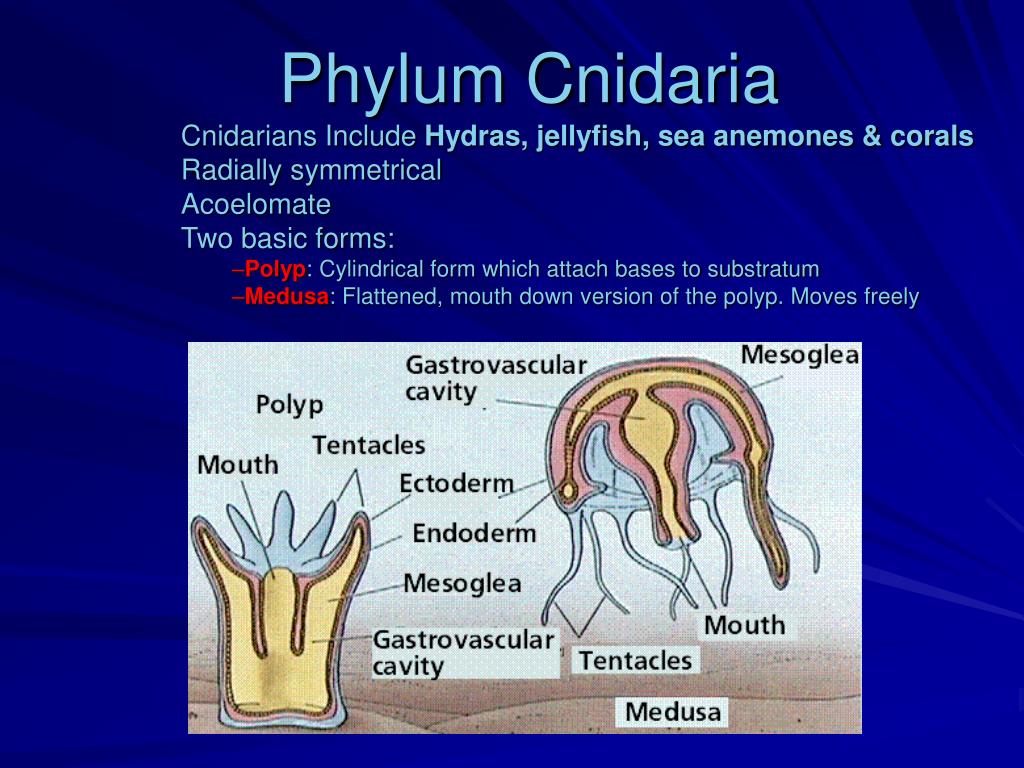
Phylum Cnidaria. Cnidarians Include Hydras, jellyfish, sea anemones & corals Radially symmetrical Acoelomate Two basic forms: Polyp : Cylindrical form which attach bases to substratum Medusa : Flattened, mouth down version of the polyp. Moves freely. Forms of Cnidarians. Body Plan.
Phylum Cnidaria - slide 1
01 / 10Phylum Cnidaria
1 / 17

Télécharger la présentation

Phylum Cnidaria
Une image / un lien ci-dessous est fourni (tel quel) pour télécharger la présentation

Politique de téléchargement : le contenu du site vous est fourni TEL QUEL pour votre information et votre usage personnel ; il ne peut être vendu, concédé sous licence ni partagé sur d’autres sites sans l’accord de son auteur.Le contenu vous est fourni TEL QUEL, pour votre information et votre usage personnel uniquement. Téléchargez la présentation en cliquant sur ce lien. Lors du téléchargement, si vous ne parvenez pas à télécharger une présentation, l’éditeur a peut-être supprimé le fichier de son serveur.Pendant le téléchargement, si vous ne parvenez pas à obtenir une présentation, le fichier a peut-être été supprimé par l’éditeur.

F I N

Plus de contenu associé

Transcription de la présentation
  1. Phylum Cnidaria Cnidarians Include Hydras, jellyfish, sea anemones & corals Radially symmetrical Acoelomate Two basic forms: Polyp: Cylindrical form which attach bases to substratum Medusa: Flattened, mouth down version of the polyp. Moves freely

  2. Forms of Cnidarians

  3. Body Plan • Basic Body Plan: • Has an outer epidermis • Has an inner gastrodermis which forms a gastrovascular cavity • Has a middle "jelly filled" layer called mesoglea

  4. Cnidocytes • Cnidarians are predators which have tentacles possessing batteries of special cells called Cnidocytes • Cnidocytes contain special stining capsules called nematocysts. • When triggered, these cells shoot out a discharge thread which can entangle and/or poison it's intended prey

  5. Reproduction • Reproduction can occur sexually by fertilization of egg and sperm forming larvae. • Reproduction can also occur asexually through budding • 3 Major classes • Class Hydrozoa: Hydras • Class Scyphozoa: Jellyfish • Class Anthozoa: Anemones and corals

  6. Class Hydrozoa: The Hydras • Polyp phase is dominant • Generally microscopic • Generally freshwater

  7. Class Scyphozoa: The Jellies • Generally refered tro as jellies • Medusa stage is dominant • Come in a variety of forms • Aggressive predators, and can be dangerous to humans Jelly Portugese Man-o-war

  8. Class Anthozoa: Anemones & Corals • Appear like plants but are animals. • Polyp form is dominant. • Corals build calcium shells to protect themselves • Have symbiotic relationship with algae. • Can build extensive masses which can form land masses. Anemone Coral Polyps

  9. Coral Reefs Clownfish living in An anemone