Understanding Big Data
Explore the power of Big Data, its impact on businesses, and how it drives decision-making. Learn about key concepts, tools, and applications in this in-depth guide.


Understanding Big Data
E N D
Presentation Transcript
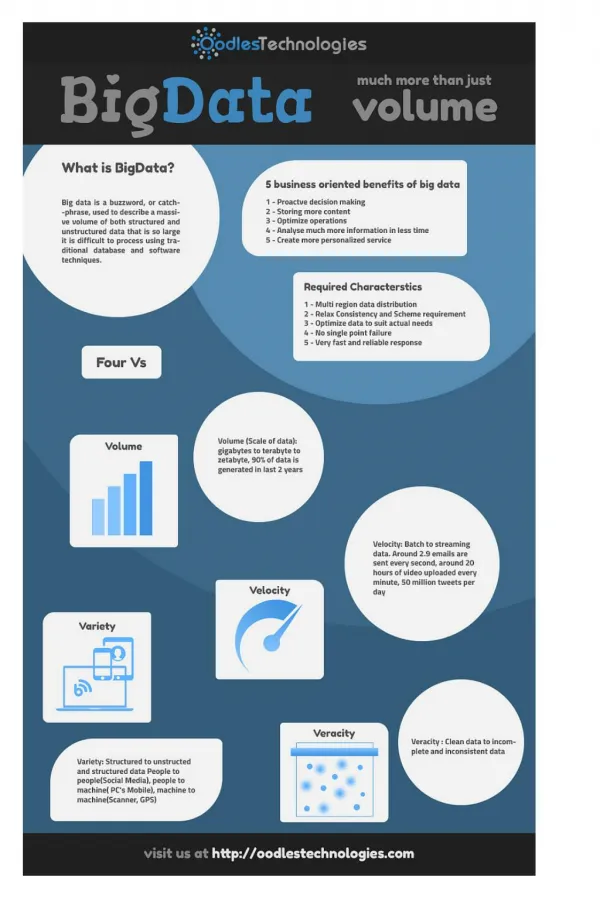
Understanding Big Data – The Power of Data- Driven Decisions Big Data is revolutionizing industries by enabling businesses to process vast amounts of information for better decision-making, automation, and predictive analytics. Companies are leveraging data-driven insights to improve operations, customer experience, and innovation. Learn more atRed9Systech Data Analyst Guide. What is Big Data? Big Data refers to large volumes of structured and unstructured data that require advanced analytics and computing techniques to process efficiently. It is characterized by the5 Vs: •Volume– Massive amounts of data generated every second. •Velocity– The speed at which data is produced and processed. •Variety– Different formats of data (structured, unstructured, semi-structured). •Veracity– Data quality and reliability. •Value– Extracting meaningful insights from data. Explore more aboutBig Data Basics.
Why is Big Data Important? 1.Enhanced Decision-Making– Enables data-driven strategies for businesses. 2.Predictive Analytics– Forecasts trends and customer behaviors. 3.Improved Operational Efficiency– Optimizes processes and reduces costs. 4.Better Customer Insights– Personalizes user experiences and improves satisfaction. 5.Competitive Advantage– Businesses leveraging Big Data outperform competitors. Read more onBig Data Benefits. Key Technologies in Big Data Technology Description Hadoop Open-source framework for distributed data processing. Apache Spark Fast, in-memory data processing engine. NoSQL Databases Handles large-scale unstructured data (MongoDB, Cassandra). Machine Learning Uses algorithms to analyze patterns and make predictions. Cloud Computing Enables scalable storage and analytics.
Applications of Big Data 1.Healthcare •Analyzes patient records for early disease detection. •Enhances personalized treatment plans and drug discovery. 2.Finance •Detects fraudulent transactions using pattern recognition. •Improves risk management and investment strategies. 3.Retail & E-commerce •Provides personalized product recommendations. •Enhances supply chain optimization and inventory management. 4.Marketing & Advertising •Uses customer data to create targeted marketing campaigns. •Enhances customer engagement and retention strategies. 5.Smart Cities •Improves traffic management and urban planning. •Optimizes energy consumption and public services. Discover moreBig Data Applications.
Challenges of Big Data 1.Data Privacy & Security •Protecting sensitive information from breaches and unauthorized access. 2.Data Quality Management •Ensuring accuracy and consistency across large datasets. 3.Scalability Issues •Managing infrastructure and resources to process huge volumes of data efficiently. 4.Regulatory Compliance •Adhering to data protection laws like GDPR and CCPA. Read more aboutData Science Guide. The Future of Big Data •AI & Big Data Integration– Enhancing predictive analytics and automation. •Edge Computing– Processing data closer to the source for real-time insights. •Blockchain for Data Security– Ensuring transparency and security in data transactions. •Quantum Computing– Revolutionizing data processing speeds and capabilities.
•Ethical AI & Responsible Data Usage– Implementing regulations for fair data practices. Stay updated withBig Data Trends. Conclusion Big Data is transforming industries with data-driven decision-making, automation, and predictive analytics. As technology advances, businesses must adopt best practices to harness the power of Big Data while addressing challenges like privacy and security. Start yourRed9SysTechJourney.