POPULAR CULTURE IN THE RENAISSANCE
250 likes | 1.02k Vues
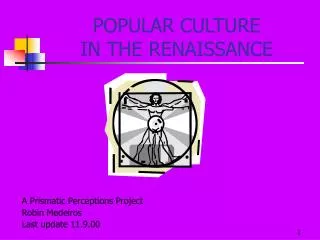
POPULAR CULTURE IN THE RENAISSANCE. A Prismatic Perceptions Project Robin Medeiros Last update 11.9.00. Purpose Definitions of culture Art Dance Fashion Festivals. Literature Music Recreation Religion Theatre. POPULAR CULTURE IN THE RENAISSANCE. PURPOSE.


POPULAR CULTURE IN THE RENAISSANCE
E N D
Presentation Transcript
POPULAR CULTURE IN THE RENAISSANCE A Prismatic Perceptions Project Robin Medeiros Last update 11.9.00
Purpose Definitions of culture Art Dance Fashion Festivals Literature Music Recreation Religion Theatre POPULAR CULTURE IN THE RENAISSANCE
PURPOSE • The purposes of this project are to: • Provide students with a model for thesis statements, outlines, research papers, and the MLA citation format (parenthetical and works cited). • Consider definitions of Popular Culture • Discuss various modes of Popular Culture in the Renaissance
THESIS STATEMENT • The study of popular culture is a 20th Century phenomenon. However by examining popular culture in the Renaissance, we can achieve a greater understanding of this historical period, as well as those who lived during this time.
CONCEPTS OF CULTURE • Definition of terms (Storey) • What is culture? • High culture • Low culture • Popular culture NOTE: Provide examples
ART • Competitors • Strengths • Weaknesses
DANCE • Court vs. folk dances • Court dances • Galliard • Pavane • Folk dances
FASHION • Clothing (Annenberg/CPB) • Discuss requirements, benefits, and issues of using new procedures
FESTIVALS • Carnivals • Parades • Gambling
LITERATUREORAL TRADITION • Folk humor • Proverbs • Songs • Stories
LITERATUREWRITTEN TRADITION • Literacy • The Written Word • Established Genres • Ballads • Plays
LITERACY • Great number of ordinary people had some knowledge of book learning • The world of work—seaman, merchants and agents of landlords jobs required regular compilation or consultation of lists must know alphabet; possess rudiments of mathematics • Richard II (1391) • Decreed any parent in the kingdom was free to send their child to school, if they could find one • Formal education (Chamberlain)
HISTORY OF THE WRITTEN WORD • Handwritten manuscripts • Army of copiers (scriptorium) at centers of learning; at each great court; monasteries • Reproduction without plan • Materials (parchment, vellum) • Due to cost, require recycling • Vellum scraped down written over (palimpsest) • Manuscripts lost forever • Archimedes palimpsest (Noel et al.)
HISTORY OFTHE WRITTEN WORD • Problems • Error through ignorance or negligence would multiply with successive editions of the work • “Establishing of the correct text” becomes a major problem • Demand for great works (e.g. The Bible) ensured their continued existence • Lesser known works • Fewer copies/ Lack of interest • Disappear for years, if not forever • As a result, people continued to struggle with problems which had already been solved in different places and times
HISTORY OFTHE WRITTEN WORD • Origins of Printing (Chamberlain) • Opened channels of communication • Work of the few swiftly available to the many • Gutenberg (Rubenstein) • The development of movable type • 1462--Civil War broke out in Maintz • Established printers settle throughout Europe • 1476--William Caxton established England’s first printing press • Earliest use print indulgences (Chamberlain)
LITERATUREWRITTEN TRADITION • Montaigne’s “poesie populaire” • Ballads (Legends) • Chanson du Roland • Orlando Furioso (Online Medieval & Classical Library) • (Bullfinch’s Mythology)
LITERATUREWRITTEN TRADITION • Established Genres • Fabliaux (Harvard College) • Romance • Morte D’Arthur (Legends) • English folk songs • Corpus Christi Carol
LITERATUREWRITTEN TRADITION--PLAYS • Development of the vernacular drama • Mystery Plays (Harvard College) • Full-text—Twycross • Four surviving cycles • Present the whole history of Mankind from the beginning to the Last Judgment • Selection of biblical episodes • Center on the life and Passion of Christ
LITERATUREWRITTEN TRADITION--PLAYS • Mystery Plays • Written by local clerics—uneven quality • Joint ecclesiastical and municipal enterprises • The Wakefield Master is recognized as the best author— • 2 Shepherds play • Part of the Wakefield Cycle (Britannica.com)
LITERATUREWRITTEN TRADITION--PLAYS • Morality Plays • Allegorical dramas • Subject not biblical history but “the life history of an individual as typical ‘Humanism Genus’ or ‘Everyman’ (The Oxford Illustrated History of English Literature) • Two surviving examples • Castle of Perservance--early 15th Century • Everyman--translated from the Dutch, early 16th Century • (Luminarium)
MUSIC • Chansons • Chanson du Roland • Ecclessiastical plainsong • Minstrels • Troubadours
RECREATION • Fighting • Football • Hunting • Jousting • Wrestling
RELIGION • High-level overview of progress against schedule • On-track in what areas • Behind in what areas • Ahead in what areas • Unexpected delays or issues