Key LTE Procedures Explained: RACH and Handover Simplified | TechLTE World
0 likes | 2 Vues
Key LTE Procedures Explained: RACH and Handover Simplified by TechLTE World is a concise and easy-to-understand guide designed for telecom learners, protocol testers, and LTE engineers.


Key LTE Procedures Explained: RACH and Handover Simplified | TechLTE World
E N D
Presentation Transcript
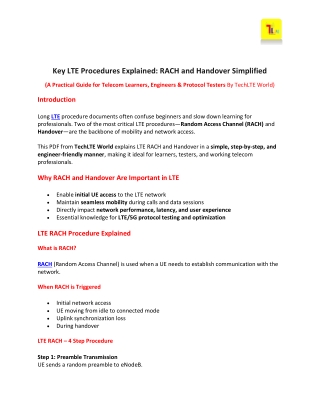
Key LTE Procedures Explained: RACH and Handover Simplified (A Practical Guide for Telecom Learners, Engineers & Protocol Testers By TechLTE World) Introduction Long LTE procedure documents often confuse beginners and slow down learning for professionals. Two of the most critical LTE procedures—Random Access Channel (RACH) and Handover—are the backbone of mobility and network access. This PDF from TechLTE World explains LTE RACH and Handover in a simple, step-by-step, and engineer-friendly manner, making it ideal for learners, testers, and working telecom professionals. Why RACH and Handover Are Important in LTE Enable initial UE access to the LTE network Maintain seamless mobility during calls and data sessions Directly impact network performance, latency, and user experience Essential knowledge for LTE/5G protocol testing and optimization LTE RACH Procedure Explained What is RACH? RACH (Random Access Channel) is used when a UE needs to establish communication with the network. When RACH is Triggered Initial network access UE moving from idle to connected mode Uplink synchronization loss During handover LTE RACH – 4 Step Procedure Step 1: Preamble Transmission UE sends a random preamble to eNodeB.
Step 2: Random Access Response (RAR) Network replies with timing advance and uplink grant. Step 3: RRC Connection Request UE sends its identity and request to connect. Step 4: RRC Connection Setup Network completes the access procedure. Why RACH Matters Controls uplink synchronization Impacts call setup time Critical for congestion handling LTE Handover Procedure Simplified What is Handover? Handover allows a UE to move from one cell to another without call drop or data interruption. Types of LTE Handover Intra-LTE Handover (Same LTE network) Inter-LTE Handover LTE to 3G/2G (Inter-RAT) LTE Handover – Key Steps 1.Measurement Report UE reports signal quality to source eNodeB. 2.Handover Decision Network decides the target cell. 3.Handover Request & Preparation Resources reserved in target cell. 4.Handover Command UE instructed to move to target cell. 5.Handover Completion UE successfully connects to target eNodeB.
Common LTE Handover Challenges Late or early handover Ping-pong handovers Radio link failure (RLF) Packet loss during mobility Understanding handover signaling helps engineers optimize KPIs and reduce call drops. RACH vs Handover – Quick Comparison Feature RACH Handover Purpose Initial Access Mobility Trigger UE request Network decision Mode Idle → ConnectedConnected → Connected Impact Access delay Call continuity Why This Guide from TechLTE World is Useful Simple language, no unnecessary theory Practical focus for protocol testing engineers Covers real LTE signaling concepts Ideal for interviews, training, and daily work About TechLTE World TechLTE World is a trusted learning platform dedicated to LTE, 5G NR, ORAN, RACH, Handover, and telecom protocols. Our goal is to make complex telecom concepts easy, practical, and job-ready. Visit: https://techlteworld.com
Conclusion Mastering LTE RACH and Handover is essential for anyone working in telecom. This simplified guide by TechLTE World helps you understand the core procedures clearly and quickly, without getting lost in lengthy documentation. Learn Share Grow