LTE RACH Procedure Simplified for Protocol Testing Engineers | TechLTE World
Understand the LTE RACH procedure with this simplified PDF guide from TechLTE World, created for protocol testing engineers. The document explains the complete RACH signaling flow, including PRACH, RAR messages, contention resolution, and common LTE access failures relevant to protocol testing and analysis. For a detailed step-by-step explanation with diagrams, you can also refer to this in-depth guide: https://techlteworld.com/rach-random-access-control-channel-in-lte-2/

LTE RACH Procedure Simplified for Protocol Testing Engineers | TechLTE World
E N D
Presentation Transcript
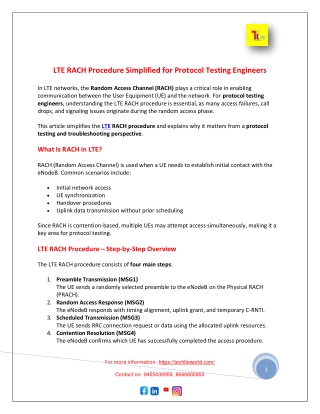
LTE RACH Procedure Simplified for Protocol Testing Engineers In LTE networks, the Random Access Channel (RACH) plays a critical role in enabling communication between the User Equipment (UE) and the network. For protocol testing engineers, understanding the LTE RACH procedure is essential, as many access failures, call drops, and signaling issues originate during the random access phase. This article simplifies the LTE RACH procedure and explains why it matters from a protocol testing and troubleshooting perspective. What Is RACH in LTE? RACH (Random Access Channel) is used when a UE needs to establish initial contact with the eNodeB. Common scenarios include: Initial network access UE synchronization Handover procedures Uplink data transmission without prior scheduling Since RACH is contention-based, multiple UEs may attempt access simultaneously, making it a key area for protocol testing. LTE RACH Procedure – Step-by-Step Overview The LTE RACH procedure consists of four main steps: 1.Preamble Transmission (MSG1) The UE sends a randomly selected preamble to the eNodeB on the Physical RACH (PRACH). 2.Random Access Response (MSG2) The eNodeB responds with timing alignment, uplink grant, and temporary C-RNTI. 3.Scheduled Transmission (MSG3) The UE sends RRC connection request or data using the allocated uplink resources. 4.Contention Resolution (MSG4) The eNodeB confirms which UE has successfully completed the access procedure. For more information- https://techlteworld.com/ Contact no- 9455439959, 8660602855 1
If contention occurs, unsuccessful UEs must retry, which is often analyzed during protocol testing. Why RACH Is Important for Protocol Testing Engineers From a protocol testing standpoint, RACH impacts: Access delay and latency Call setup success rate Handover reliability Network congestion handling Engineers frequently monitor RACH-related KPIs such as preamble success rate, collisions, and access failures to identify performance bottlenecks. Common RACH Issues Observed in Testing Some typical RACH-related issues include: High preamble collision rate Delayed Random Access Response MSG3 transmission failures Contention resolution timeouts Identifying these issues early helps improve LTE network stability and user experience. Learning RACH with Practical Examples While theoretical knowledge is important, visual call flows, logs, and real protocol traces make RACH easier to understand. Platforms like TechLTE World provide detailed explanations, diagrams, and protocol testing insights that help engineers bridge the gap between theory and real-world LTE scenarios. For engineers preparing for LTE protocol testing roles, mastering RACH is a foundational skill that improves troubleshooting accuracy and network analysis efficiency. For more information- https://techlteworld.com/ Contact no- 9455439959, 8660602855 2
Conclusion The LTE RACH procedure is a small but critical part of LTE signaling. By understanding its steps, common issues, and testing relevance, protocol engineers can effectively diagnose access- related problems and improve overall network performance. Whether you are a beginner or an experienced tester, simplifying RACH concepts is the first step toward mastering LTE protocol analysis. For more information- https://techlteworld.com/ Contact no- 9455439959, 8660602855 3







![Simplified X1 Protocol [1]](https://cdn2.slideserve.com/3911985/simplified-x1-protocol-1-dt.jpg)