Download
1 / 9
90 likes | 209 Vues
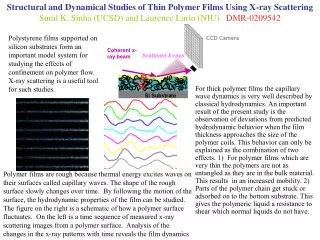
This project, led by Andreas Walther and Atia Amari, explores the efficient storage and reconstruction of single photons using a multi-pass crystal setup. Key topics include the methodology of ray tracing, design optimization of crystal holders, and the analysis of reflected beam overlap. Utilizing hands-on experience with the FRED software, the study aims to achieve high absorption rates through waveguide configurations and electrostatic designs. The results demonstrate significant advancements in the understanding of quantum state storage and crystal optics.

E N D
Optical Ray -TracingCoherent beam propagation in a Multi-Pass crystal By Andreas Walther and Atia Amari
Outline • Background • What information can we get from Raytracing? • Methods / Hands-on FRED experience • Results
Quantum state storage project The goal of the project is to demonstrate efficient storage and reconstruction of single-photon. The complete quantum field is stored To achieve this we may require that: --- High absorption ( a L >> 1 )
To achieve sufficient absorption depth : • Waveguides - Crystalline fiber - Multi-pass configuration
AR HR Electrodes Multipasscrystal
What information can we get from Raytracing ? • Bulid crystal holder (how do we design it?) • Optimize the beam inside the crystal • - Constant beam waist • - Better accuracy on ray length • Study reflected beam overlap
3000 2500 2000 irradiance (arb. u.) 1500 1000 500 0 10 400 200 Reflective surface 9.5 0 9 -200 length (μm) distance from surface (mm) 8.5 -400 What information can we get from Raytracing ? Reflected beam overlap:
Real part 40 20 amplitude (arb. u.) 0 -20 -40 -300 -200 -100 0 100 200 300 Imaginary part sum 40 Irradiance (sum squared) only incoming 2000 only reflected 20 sum 1500 only incoming amplitude (arb. u.) only reflected 0 irradiance (arb. u.) 1000 -20 500 -40 -300 -200 -100 0 100 200 300 0 -300 -200 -100 0 100 200 300 1500 1000 500 0 -300 -200 -100 0 100 200 300 What information can we get from Raytracing ? Coherent addition: Surface @ 9.6 mm length (μm) Surface @ 9.6 mm + λπ/2 length (μm) length (μm)
Concluding remarks about FRED • Pros • Very easy to learn the basics, like creating objects • Broad range of tools/customization • Fast computation • Cons • Non-intuitive script language with no debugging tools • Documentation could be better • No compatability with other programs (like origin/matlab) But all in all, a very useful program, that actually gave us a lot of info