SlideServe
Menu
Préférences
© SlideServe · v2026

Ray tracing in an optical system

duena avatar
34 diapositives · 550 Views · Jul 13, 2012

Ray matrix. What we need to describe a ray in an optical system.1.Where is it with respect to some arbitrarily chosen axis?2.In what direction is it heading?We start with inspection of the length of free space.We assume that all rays are paraxial, thus the angle
Ray tracing in an optical system - slide 1
01 / 34Ray tracing in an optical system
1 / 17

Télécharger la présentation

Ray tracing in an optical system
Une image / un lien ci-dessous est fourni (tel quel) pour télécharger la présentation

Politique de téléchargement : le contenu du site vous est fourni TEL QUEL pour votre information et votre usage personnel ; il ne peut être vendu, concédé sous licence ni partagé sur d’autres sites sans l’accord de son auteur.Le contenu vous est fourni TEL QUEL, pour votre information et votre usage personnel uniquement. Téléchargez la présentation en cliquant sur ce lien. Lors du téléchargement, si vous ne parvenez pas à télécharger une présentation, l’éditeur a peut-être supprimé le fichier de son serveur.Pendant le téléchargement, si vous ne parvenez pas à obtenir une présentation, le fichier a peut-être été supprimé par l’éditeur.

F I N

Plus de contenu associé

Transcription de la présentation

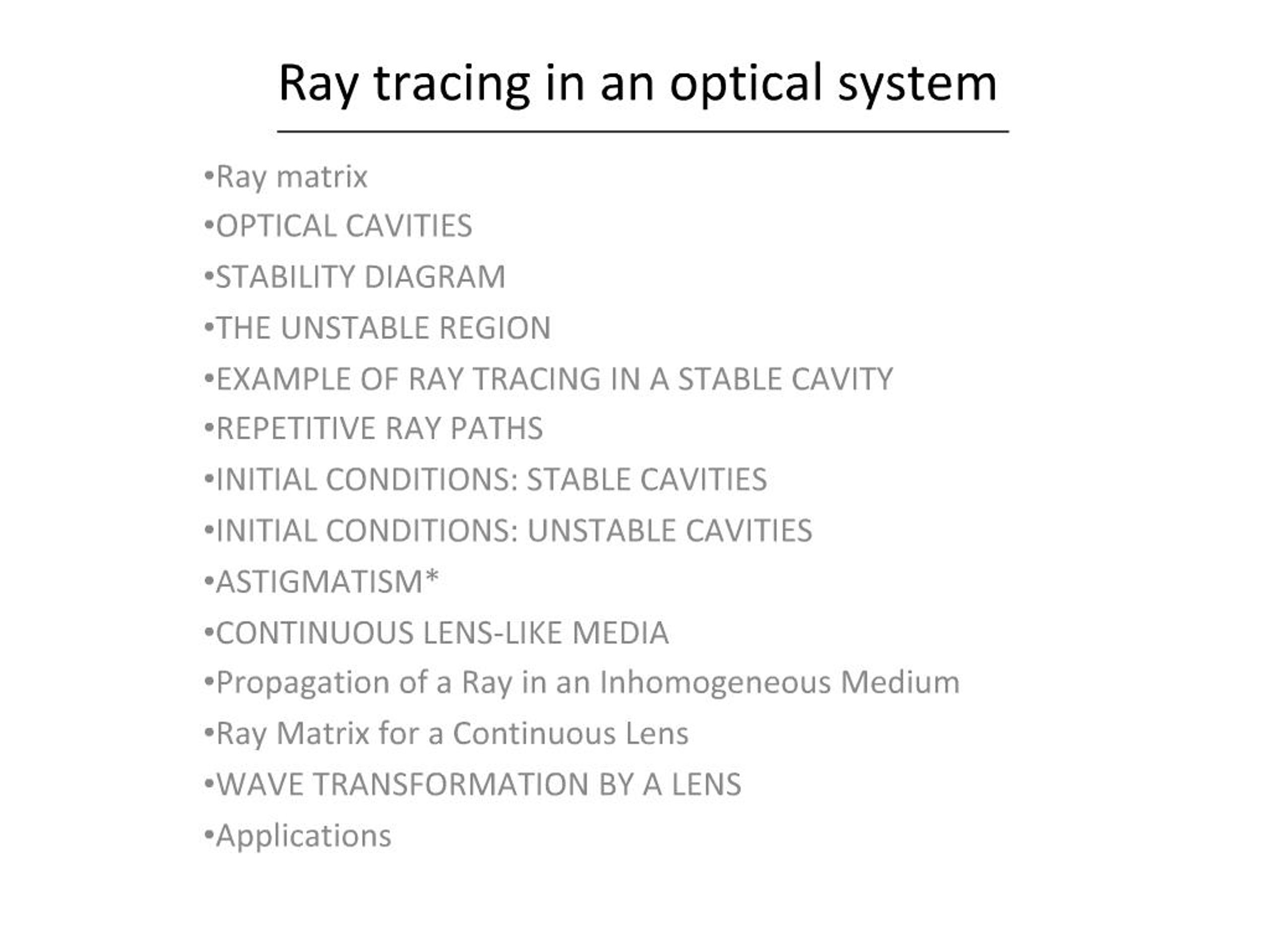
    1. Ray tracing in an optical system Ray matrix OPTICAL CAVITIES STABILITY DIAGRAM THE UNSTABLE REGION EXAMPLE OF RAY TRACING IN A STABLE CAVITY REPETITIVE RAY PATHS INITIAL CONDITIONS: STABLE CAVITIES INITIAL CONDITIONS: UNSTABLE CAVITIES ASTIGMATISM* CONTINUOUS LENS-LIKE MEDIA Propagation of a Ray in an Inhomogeneous Medium Ray Matrix for a Continuous Lens WAVE TRANSFORMATION BY A LENS Applications

    2. Ray matrix What we need to describe a ray in an optical system. 1. Where is it with respect to some arbitrarily chosen axis? 2. In what direction is it heading? We start with inspection of the length of free space. We assume that all rays are paraxial, thus the angle equals the slop of the ray, r’.