Understanding Phase Changes of Water and Carbon Dioxide: Diagrams and Key Concepts
This guide covers the fundamental concepts of phase changes, specifically for water and carbon dioxide, detailing how energy is released or absorbed during transitions such as freezing, melting, condensation, and evaporation. It also explores the relationship between pressure and boiling points, introducing phase diagrams that represent phases as functions of temperature and pressure. Key terms such as critical temperature and critical pressure are defined, highlighting their importance in understanding phase behavior.

Understanding Phase Changes of Water and Carbon Dioxide: Diagrams and Key Concepts
E N D
Presentation Transcript
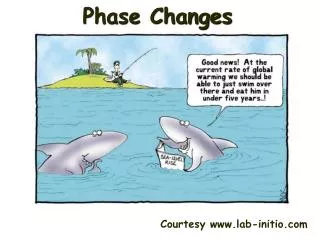
Phase Changes Courtesy www.lab-initio.com
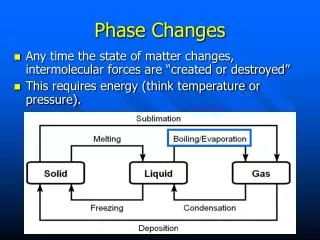
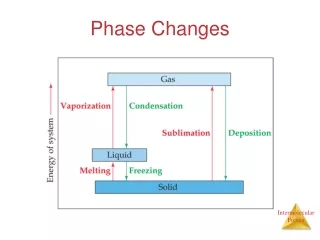
CA Standards • Students know energy is released when a material condenses or freezes and is absorbed when a material evaporates or melts.
constant Temperature remains __________ during a phase change. Water phase changes
Phase Diagram • Represents phases as a function of temperature and pressure. • Critical temperature: temperature above which the vapor can not be liquefied. • Critical pressure: pressure required to liquefy AT the critical temperature. • Critical point: critical temperature and pressure (for water, Tc = 374°C and 218 atm).
Phase Diagram for Carbon dioxide Carbon dioxide
Carbon Phase Diagram for Carbon