Advancements in Polyolefin Blend Miscibility: Insights from Oklahoma State University
This report details new findings on polyolefin blend miscibility from the research group led by Dr. Jeffery L. White at Oklahoma State University. Significant advancements have been made in defining and detecting miscibility in macromolecular mixtures, highlighting the role of configurational entropy in polymer thermodynamics. Additionally, the group's educational outreach program, "I-PROD," aims to spark science interest among elementary students through engaging hands-on activities. The project's contributions are supported by an NSF grant and have garnered attention from the Oklahoma State Board of Education.

Advancements in Polyolefin Blend Miscibility: Insights from Oklahoma State University
E N D
Presentation Transcript
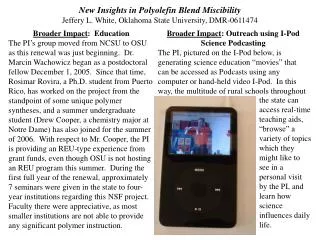
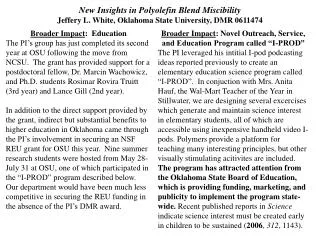
New Insights in Polyolefin Blend MiscibilityJeffery L. White, Oklahoma State University, DMR 0611474 Broader Impact: Education The PI’s group has just completed its second year at OSU following the move from NCSU. The grant has provided support for a postdoctoral fellow, Dr. Marcin Wachowicz, and Ph.D. students Rosimar Rovira Truitt (3rd year) and Lance Gill (2nd year). In addition to the direct support provided by the grant, indirect but substantial benefits to higher education in Oklahoma came through the PI’s involvement in securing an NSF REU grant for OSU this year. Nine summer research students were hosted from May 28-July 31 at OSU, one of which participated in the “I-PROD” program described below. Our department would have been much less competitive in securing the REU funding in the absence of the PI’s DMR award. Broader Impact: Novel Outreach, Service, and Education Program called “I-PROD” The PI leveraged his intitial I-pod podcasting ideas reported previously to create an elementary education science program called “I-PROD”. In conjuction with Mrs. Anita Hauf, the Wal-Mart Teacher of the Year in Stillwater, we are designing several excercises which generate and maintain science interest in elementary students, all of which are accessible using inexpensive handheld video I-pods. Polymers provide a platform for teaching many interesting principles, but other visually stimulating acitivites are included. The program has attracted attention from the Oklahoma State Board of Education, which is providing funding, marketing, and publicity to implement the program state-wide. Recent published reports in Science indicate science interest must be created early in children to be sustained (2006, 312, 1143).
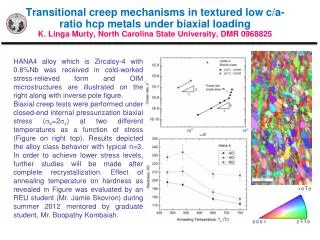
New Insights in Polyolefin Blend MiscibilityJeffery L. White, Oklahoma State University, DMR 0611474 Detecting, defining, and creating miscibility in mixtures of macromolecules continues to drive our experimental approaches. During the last year, we have made a quantum leap forward in the quantitative aspects of defining and detecting miscibility. Our group has recently published the only quantitative study to date (Macromolecules, 2007, 40, 5433-5440) for very slow chain reorientations (10-100 Hz) in a miscible blend in which both polymers in the blend are studied simultaneously but with chain specificity. The results unequivocally indicate the role that configurational entropy plays in macromolecular thermodynamics, and we are pleased that these same entropy ideas are beginning to propagate in the biological macromolecule literature as a route for enzyme/protein activity. We have been encouraged by leading scientists to attack proteins using our experimental strategies in the future. In addition, several review article invitations and invited lectures have been requested of the PI. In the two graphs on the right, we show that slow chain motions converge to the same correlation time/temperature values for a miscible polyolefin blend. This new finding promises to help design miscible systems by managing entropy in polymer structures. In contrast, the PP/PE- copolymer blend in the bottom graph does not converge to the same correlation time/temperature plateau, indicating that the system is not mixed at the chain level. The entropy of mixing is negative.