Exploring the Impact of Driving and Personal Experiences
This activity encourages students to reflect on their personal feelings about driving and its implications in their lives. They will engage with questions about their emotions related to driving, explore who will help them hone their driving skills, and consider the safety implications of driving as influenced by human factors. Additionally, students will examine motorcycle safety, analyze the critical vision requirements for driving, and discuss potential changes to their school environment, fostering a deeper understanding of both driving responsibilities and personal reflections.

Exploring the Impact of Driving and Personal Experiences
E N D
Presentation Transcript
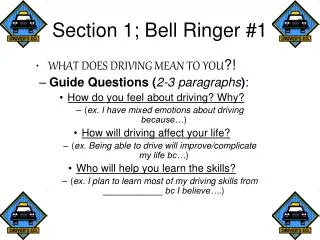
Section 1; Bell Ringer #1 • WHAT DOES DRIVING MEAN TO YOU?! • Guide Questions (2-3 paragraphs): • How do you feel about driving? Why? • (ex. I have mixed emotions about driving because…) • How will driving affect your life? • (ex. Being able to drive will improve/complicate my life bc…) • Who will help you learn the skills? • (ex. I plan to learn most of my driving skills from ____________ bc I believe….)
Section 1- Bell Ringer #2 “Cars do not crash–people crash them.” YES or NO? In 2-3 paragraphs, give a detailed explanation of the statements listed above. • Consider the following to support your answer: • Driver error • Car performance • Driver experience • Etc. • Give specific examples
Class-Work Vision StandardsDMVM – pg. 4 • What are the minimum vision requirements in order to drive without a restricted driver’s license? • What is the vision score that would restrict you to driving during daylight hours only? • What happens if you fail the vision screening? • Can you wear your glass or contact lenses during the vision screening?
Section 1 Bell Ringer #3 • Take a moment to examine the picture and gather information. • FACT or FICTIONyour choice. In 2-3 paragraphs, write a story about what you think is going on in this picture. Consider the following: • Who is involved? • What is the situation? • When is it occurring? • Where is this taking place? • Why do these cars appear this way?
Class-Work Motorcycles TEXTBOOK p. 237 • List 3 characteristics of two-wheeled vehicles as stated on p. 237 from the textbook. • READ. “Dangerous Roadway Conditions”. Why must cyclists make a much more major adjustment in speed or position than a driver in a vehicle? • Which traffic laws do cyclists have to obey? FACT: In 2008, motorcyclist fatalities continued their 11-year increase, reaching 5,290.
Define & Discuss: • Suspension (DMVM p. 27): • Revocation or Revoked (DMVM p. 27):
READ p.27 • The court or DMV will suspend or revoke your privilege to drive if you are convicted of any of the following offenses:
Class Work - Suspension and RevocationDMVM- pg. 28 • Under Age 18: If you are convicted of a demerit point violation, when are you required to complete a driver improvement clinic? • What happens if you do not complete the clinic within the required time? • Under Age 18: What are the consequences after your 2nd & 3rd conviction for a demerit point? • Age 18 or Older: If you are age 18 or older what happens if you: • Accumulate 12 demerit points in 12 months (18 in 24 months) • Accumulate 18 demerit points in 12 months (24 in 24 months)
Section 1, Bell Ringer #4 “If I could change anything about this school, I would…” • Complete the sentence. • In 2-4 paragraphs, explain your decision for change. • (Who, what, when, where, why)
S1; B.R. #5 • I knew it was going to be a bad day when I woke up and… • What happened to make your day bad? • What needs to happen to turn it into a good day? • 2-3 paragraphs.