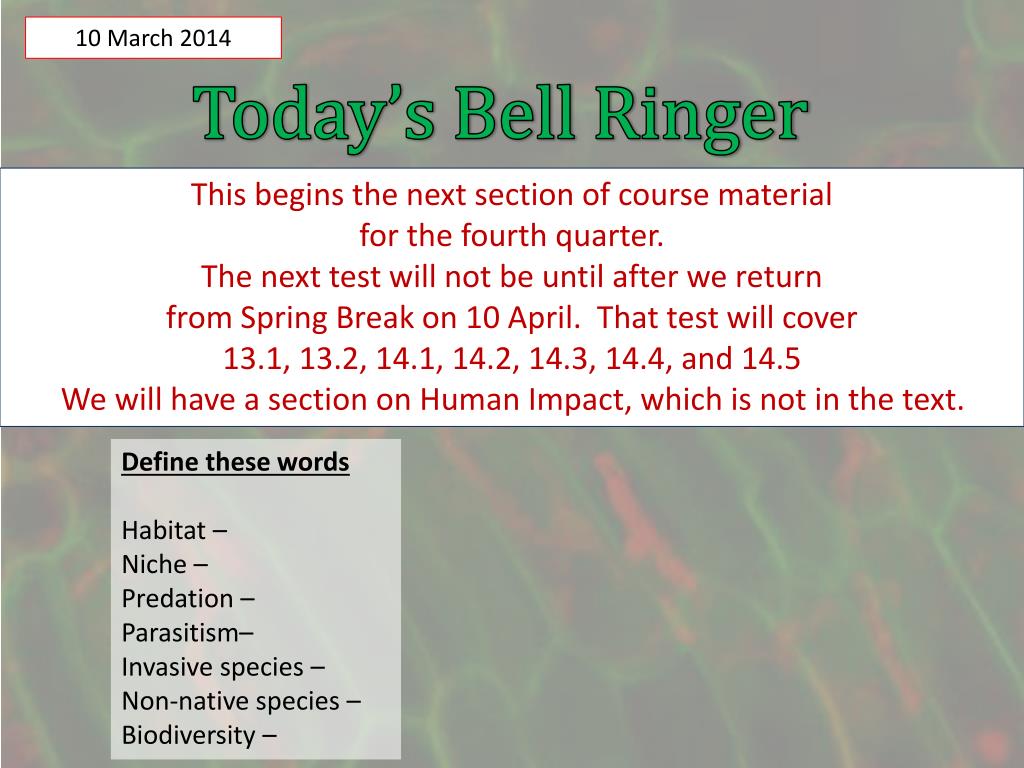
10 March 2014. Today’s Bell Ringer. This begins the next section of course material for the fourth quarter. The next test will not be until after we return from Spring Break on 10 April. That test will cover 13.1, 13.2, 14.1, 14.2, 14.3, 14.4, and 14.5
Une image / un lien ci-dessous est fourni (tel quel) pour télécharger la présentation
Politique de téléchargement : le contenu du site vous est fourni TEL QUEL pour votre information et votre usage personnel ; il ne peut être vendu, concédé sous licence ni partagé sur d’autres sites sans l’accord de son auteur.Le contenu vous est fourni TEL QUEL, pour votre information et votre usage personnel uniquement.Téléchargez la présentation en cliquant sur ce lien.Lors du téléchargement, si vous ne parvenez pas à télécharger une présentation, l’éditeur a peut-être supprimé le fichier de son serveur.Pendant le téléchargement, si vous ne parvenez pas à obtenir une présentation, le fichier a peut-être été supprimé par l’éditeur.
F I N
Plus de contenu associé
Transcription de la présentation
10 March 2014 Today’s Bell Ringer This begins the next section of course material for the fourth quarter. The next test will not be until after we return from Spring Break on 10 April. That test will cover 13.1, 13.2, 14.1, 14.2, 14.3, 14.4, and 14.5 We will have a section on Human Impact, which is not in the text. Define these words Habitat – Niche – Predation – Parasitism– Invasive species – Non-native species – Biodiversity –
Resource availability gives structure to a community. • Species can share habitats and resources. • Competition occurs when two species use resources in the same way. • Competitive exclusion keeps two species from occupying the same niche.
A habitat differs from a niche. • A habitat is all aspects of the area in which an organism lives. • biotic factors • abiotic factors • An ecological niche includes all of the factors that a species needs to survive, stay healthy, and reproduce. • food • abiotic conditions • behavior
Commensalism Human Our eyelashes are home to tiny mites that feast on oil secretions and dead skin. Without harming us, up to 20 mites may be living in one eyelash follicle. Ø Demodicids Eyelash mites find all they need to survive in the tiny follicles of eyelashes. Magnified here 225 times, these creatures measure 0.4 mm in length and can be seen only with a microscope. + Ø + Organism is not affected Organism benefits • There are three major types of symbiotic relationships. • Commensalism: one organism benefits, the other is unharmed
+ Braconid wasp Braconid larvae feed on their host and release themselves shortly before reaching the pupae stage of development. + Parasitism _ Hornworm caterpillar The host hornworm will eventually die as its organs are consumed by wasp larvae. _ Organism benefits Organism is harmed • There are three major types of symbiotic relationships. • Parasitism: one organism benefits, the other is harmed +
11 March 2014 Today’s Bell Ringer Define these words Competition – Population density – Immigration – Emigration – Carrying capacity – Limiting factors –
This species is highly invasive.[3] In its introduced range, it reaches exceptionally high population densities, is capable of expanding its range very quickly, and both outcompetes and consumes many species of native lizards.[4][5][6] The brown anole's introduction into the United States in the early 1970s[7] http://en.wikipedia.org/wiki/Brown_anole 5. Campbell, T.S. 2000. Analysis of the effects of an exotic lizard (Anolissagrei) on a native lizard (Anoliscarolinensis) in Florida, using islands as experimental units. PhD Thesis, Univ. of Tennessee. 6. Gerber, G.P. and Echternacht, A.C. 2000. Evidence for asymmetrical intraguild predation between native and introduced Anolis lizards. Oecologia 124: 599-607. 7. R.D. and Patti Bartlett (2013). "Choosing a Brown Anole" PetPlacedot com. Retrieved 2013-01-16.
Changes in a population’s size are determined by immigration, births, emigration, and deaths. • The size of a population is always changing. • Four factors affect the size of a population. • immigration • births • emigration • deaths
Ecological factors limit population growth. • A limiting factor is something that keeps the size of a population down. • Density-dependent limiting factors are affected by the number of individuals in a given area.
13 March 2014 Today’s Bell Ringer • What happens to the landscape (a forest) after a volcanic eruption or massive, destructive fire? • Which plants come back first? • Why? • If the catastrophic event happens again, will the same plants come back in the same way? • Work in groups of two or three to answer these questions. Define these words Succession – Pioneer species – Climax Community –
Succession occurs following a disturbance in an ecosystem. • Succession regenerates or creates a community after a disturbance. • a sequence of biotic changes • damaged communities are regenerated • new communities arise in previously uninhabited areas
14 March 2014 Today’s Bell Ringer Guest speaker Ms. Elliott – University of Central Florida. Topic: Human Impact – Extra Credit opportunity – Go to http://donspence.wikispaces.comto find the questions related to her talk. Then, log into http://turnitin.com and submit your questions by 8 AM on Monday, 17 March. Watch COSMOS – Last week’s full episode. Sunday, 9 PM on FOX http://www.fox.com/watch/183733315515
Extra Credit Questions: Log onto http://turnitin.com All answers must be thorough and in proper grammatical form. The answers all together should be at least 600 words. In ways did Ms. Elliott’s presentation tie in with our recentchapter course material? Were there any new words or concepts that that had not been discussed in Dr. Spence’s class? Describe the concept as best as you remember it. Describe three reasons why non-native, invasive species are a problem for society? From an ecological topic aspect, what did you find the most interesting about her talk? If the answer is ‘none’ then explain why ecological studies are of little use.
31 March 2014 Today’s Bell Ringer – Welcome Back – Review mock EOC exam
2 April 2014 Today’s Bell Ringer Human Impact Chapter 16 Renewable resources – Non-renewable resources – Pollution – Smog – Acid Rain – Greenhouse effect – Global warming – Fossil fuels – Indicator species – Biomagnification – Bioaccumulation – Habitat Fragmentation – Sustainability –
wind • water • sunlight • Renewable resources cannot be used up or can replenish themselves over time. • Growing use of nonrenewable resources may lead to a crisis. • Resources must be properly managed.
Effective management of Earth’s resources will help meet the needs of the future. • Earth’s resources must be used responsibly. • Careless use of resources makes them unavailable to future generations. • Easter Island isan example ofirresponsibleresource use.
3 April 2014 Today’s Bell Ringer Human Impact and the Geophysical world around us On a sheet of paper, write a brief explanation stating your understanding of these concepts. - do not use your book 1- Ozone depletion 2- Global warming 3- What things do you use that are dependent on energy? List a few. Which is the most energy demanding?
Connexion au compte
Connectez-vous pour publier votre contenu sur SlideServe.