Exploring Radio Telescopes: Focusing Signals with Curved Mirrors and Wire Mesh
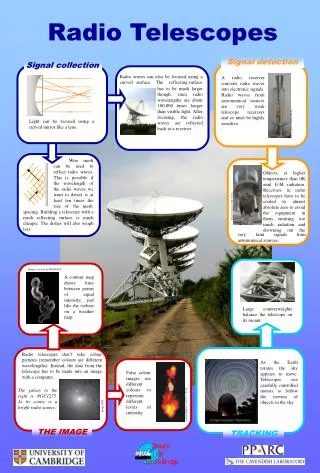
Radio telescopes utilize curved mirrors and wire mesh to focus and detect weak radio waves from astronomical sources. The mesh acts as a reflector for radio waves, especially effective when the wavelength is at least ten times the mesh spacing. Although radio wavelengths are significantly longer than visible light, these telescopes can be built more affordably and with less weight. To avoid interference, receivers must be cooled to near absolute zero, enhancing sensitivity to faint signals. Data is processed into images, revealing cosmic phenomena such as galaxies and stars.

Exploring Radio Telescopes: Focusing Signals with Curved Mirrors and Wire Mesh
E N D
Presentation Transcript
Signal collection Light can be focused using a curved mirror like a lens. Wire mesh can be used to reflect radio waves. This is possible if the wavelength of the radio waves we want to detect is at least ten times the size of the mesh spacing. Building a telescope with a mesh reflecting surface is much cheaper. The dishes will also weigh less. Radio Telescopes Signal detection Radio waves can also be focused using a curved surface. The reflecting surface A radio receiver converts radio waves into electronic signals. Radio waves from astronomical sources are very weak telescope receivers and so must be highly sensitive. has to be much larger though, since radio wavelengths are about 100,000 times longer than visible light. After focusing, the radio waves are reflected back to a receiver. Image Courtesy of M. Crofts Objects at higher temperatures than 0K emit E-M radiation. Receivers in radio telescopes have to be cooled to almost absolute zero to avoid the equipment in them emitting too much radiation and drowning out the Image Courtesy of M. Crofts very faint signals from astronomical sources. Image courtesy of NRAO/AUI A contour map draws lines between points of equal intensity, just like the isobars on a weather map. Large counterweights balance the telescope on its mount. Radio telescopes don’t take colour pictures (remember colours are different wavelengths). Instead, the data from the telescope has to be made into an image with a computer. As the Earth rotates the sky appears to move. Telescopes use carefully controlled motors to follow the motion of objects in the sky. False colour images use different colours to represent different levels of intensity. The galaxy to the right is NGC1275. At its centre is a bright radio source, Image courtesy of NRAO/AUI Image HST THE IMAGE TRACKING