
Mutations: Types, Effects, and Causes
E N D
Presentation Transcript
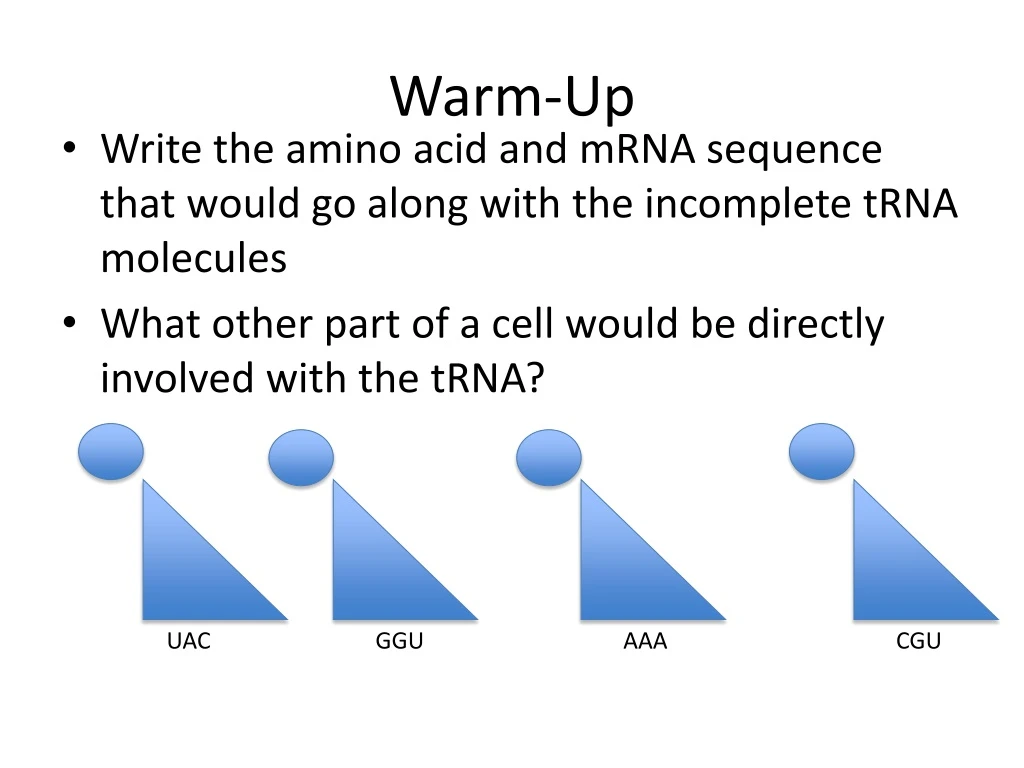
Warm-Up • Write the amino acid and mRNA sequence that would go along with the incomplete tRNA molecules • What other part of a cell would be directly involved with the tRNA? UAC GGU AAA CGU
Mutations can effect a single gene or an entire chromosome • Mutation- a change in an organism’s DNA • Usually mutations that affect a single gene happen during replication while one that affects many genes or an entire chromosome happen during meiosis (replication of gametes- eggs and sperm)
Gene Mutations • 2 types: • Point mutation • One nucleotide gets substituted for another • Most often mistake is caught by DNA Polymerase but if not, it will continue to be replicated • Frameshift mutation • Insertion or deletion of a nucleotide • Generally has a worse effect on the protein than point because it shifts the whole sequence
Example of Frameshift Mutations • From page 252 • Consider this DNA nucleotide sequence: THE CAT ATE THE RAT • Now if you had a deletion of the E in the first THE, look what happens: THC ATA TET HER AT… • What has happened to the reading frame? How would this effect the mRNA strand (and therefore the sequence of amino acids)?
Chromosomal Mutations • Can result in duplicate or missing copies of entire genes gene duplication/deletion • Can result in a piece of one chromosome connecting to a piece of a nonhomologous chromosomes (a different chromosome, the wrong one) gene translocation *we will discuss chromosomal mutations in more detail after we talk about meiosis
Mutations may or may not affect phenotype • Phenotype- physical characteristics • Whether it affects it or not depends on number of genes involved, location of the mutation, function of gene etc • Mutations that occur in body cells ONLY affect that organism • Mutations that occur in germ cells (eggs and sperm) can affect offspring • This is what creates genetic variation, the basis of natural selection
What Causes Mutations? • Natural replication errors missed by DNA replication • These accumulate over time (one major cause of aging) • Mutagens • Agents in the environment that can change DNA • Can break DNA strands • Can speed up the rate of replication errors • Natural sources (like UV light) and chemicals (like cigarettes)