POINTERS
This article introduces the concept of pointers in the C programming language, emphasizing their ability to manipulate memory directly. Beginners will learn how pointers enhance flexibility but can also present challenges. By understanding how to retrieve variable addresses using the `&` operator and dereference pointers with the `*` operator, programmers gain insights into memory allocation and data handling. The article includes practical examples, including defining pointers and accessing values, making it essential for mastering C programming fundamentals.

POINTERS
E N D
Presentation Transcript
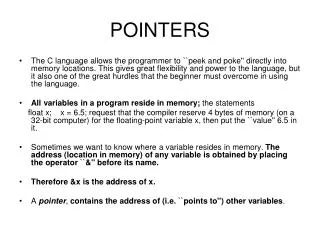
POINTERS • The C language allows the programmer to ``peek and poke'' directly into memory locations. This gives great flexibility and power to the language, but it also one of the great hurdles that the beginner must overcome in using the language. • All variables in a program reside in memory; the statements float x; x = 6.5; request that the compiler reserve 4 bytes of memory (on a 32-bit computer) for the floating-point variable x, then put the ``value'' 6.5 in it. • Sometimes we want to know where a variable resides in memory. The address (location in memory) of any variable is obtained by placing the operator ``&'' before its name. • Therefore &x is the address of x. • A pointer, contains the address of (i.e. ``points to'') other variables.
POINTERS • For example: float x; float* px; x = 6.5; px = &x;defines px to be a pointer to objects of type float, and sets it equal to the address of x:
Pointer use for a variable The content of the memory location referenced by a pointer is obtained using the ``*'' operator (this is called dereferencing the pointer). Thus, *px refers to the value of x. E.g. #include <iostream> Using namespace std; void main( ){ int nom; int* n; nom = 100; n = &nom; cout<<nom<<n<<&nom<< &n<<*n ); } * A pointer keeps/contains only the address of another variable. POINTERS