Real-Time Monitoring & Diagnostic Solution for HVAC Systems
340 likes | 467 Vues
This presentation outlines a project by ECE Team 169 to enhance HVAC systems through a real-time monitoring and diagnostic solution. Key objectives include building upon previous designs by updating an HVAC diagnostic model, acquiring real-time data from building sensors, and developing failure-detection code. Sponsored by Qualtech Systems, the project uses TEAMS (Testability Engineering and Maintenance System) software to analyze system performance, detect failures, and provide actionable insights. It addresses challenges faced, lessons learned, and the overall project timeline and budget.


Real-Time Monitoring & Diagnostic Solution for HVAC Systems
E N D
Presentation Transcript
Real-time Monitoring and Diagnostic Solution for an HVAC System ECE Team 169 Anthony Bellantoni (EE) Greg Carmichael (EngrPhys) Joe Grassi (EE) Sponsored by: Qualtech Systems Inc. Advisor: ProfessorJohn Chandy
Presentation Outline • Project Goals • Brief Explanation of Qualtech Systems, Inc. • Overview of TEAMS Software • HVAC Explanation • Updated and Completed Model • Overview of Detecting a Failure • Project Timeline & Budget • Project Limitations • Lessons Learned
Project Goals •Fix & Build Upon Previous Incomplete Senior Design Project - Update Diagnostic HVAC Model for ITEB • Obtain real-time data from the building sensors - Develop Failure-Detection Code •Combine model and code to detect for faults in real-time.
Qualtech Systems, Inc. •Located in East Hartford, Connecticut (Founded in 1993) • Provide advanced system health management, integrated diagnostics and telemaintenance • Works on any system • Helps improve equipment productivity •TEAMS - Testability Engineering and Maintenance System
TEAMS • Testability Engineering and Maintenance System • Consists of Multiple Components • Designer • RDS • Remote Diagnostic Server • RT • “Real-Time” Data Collection http://tomgpalmer.com/wp-content/uploads/legacy-images/FLASH%20LIGHT.jpg
TEAMS - Designer • Used to create a model of a system, including components with their respective test points • Can be used to model any complex system (e.g.-MRI, Car, Building, etc.)
TEAMS - RDS • Online Server that connects all components of TEAMS software • Decides Which Component is Most Likely Failing From the Designer • Provides Possible Solutions during Manual Maintenance • Stores information gathered for future analyses
TEAMS - RT • Provides Diagnostics in Real-Time • Connects Developed Code with Generated Sensor Values to RDS • Allows for constant connection
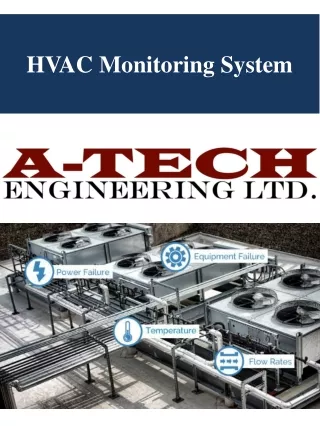
What is HVAC? • Heating Ventilation and Air Conditioning • Processes Air in a Building, Vehicle, or Other Structure • Maximize Occupant(s) Comfort Of Enclosed Area • Range from “Central Air” in Residential Homes to Complex Multi-Building Systems
ITE HVAC System • Basement (Heat Exchanger) • Tunnel to COGEN plant • Penthouse (Air Handler) • VAV (Variable Air Volume) • One For Each Room • Measured on Every Floor at Every Point in System
Failure Detection Code Process 1) Extract sensor values from text file and determine whether or not a failure is occurring 2) Export results file into TEAMS-RT 3) TEAMS-RT combines test results with our model and determines possible failure points
How to Determine a Failure • Set threshold value for maximum deviation from set point • Cannot assume failure after one test • Initiate a counter to determine number of tests in a row that fail • If consecutive tests trend toward the set point, counter returns to 0 • If deviation from the set point is less than the maximum allowed, counter returns to 0 • If n tests in a row fail and do not approach set point, assume failure
Failure-Detection Method Sensor 1 Extract sensor data from txt, determine if failure occurs, then store in either 'pass' or 'fail' txt file. Temperature Sensor 2 Export results to TEAMS-RT Humidity Sensor n
Project Budget http://www.rosemarierealty.com/wp-content/uploads/2012/03/dreamstime_xs_17999966-300x300.jpg http://blog.outreach.com/wp-content/uploads/2011/09/Church-events-on-no-Budget.jpg http://static.seekingalpha.com/uploads/2009/3/4/saupload_mar04_09_bm.jpg http://i.crn.com/images/free_cloud_400.jpg
Final Tasks • Connect our Failure Results with TEAMS RT • Connecting RT with RDS
Project Limitations • Obtaining access to actual sensor valuesMaintenance cost/time value for each component • No access to maintenance costs held by UConn Facilities • Restricted to remote server for TEAMS
Lessons Learned • TEAMS is capable of modeling large systems • Difficult for beginners and requires expert knowledge to build • HVAC systems are complex • Prepare for setbacks • Information from facilities • Remote server issues