Gene regulation
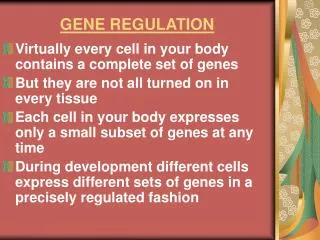
All cells contain a complete set of DNA, but only a subset is expressed, generating diverse cell types like nerve, cardiac, and muscle cells. Gene regulation involves promoters and repressors that determine gene expression. For example, lactose binding to a repressor activates the breakdown of lactose. Eukaryotic genes often have a TATA box to aid RNA polymerase positioning. As cells differentiate from a fertilized egg, Hox genes play a crucial role in this process. Mutations can impact gene function, with small changes sometimes leading to significant effects on an organism.
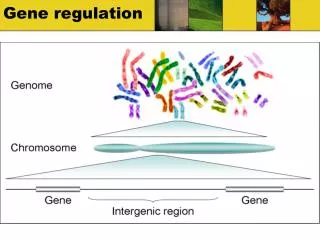

Gene regulation
E N D
Presentation Transcript
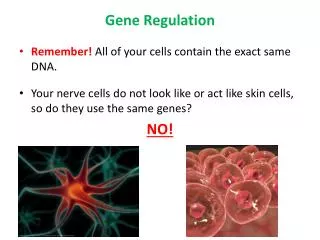
How does DNA make different cells? • All cells have a full set of DNA • Not all the DNA is expressed in each one • Promoters and repressors allow only certain genes to be expressed (make protein) Nerve, cardiac, muscle, white blood cells
How it works • When lactose is added, it binds to the repressor protein.
Activation Left side: why do you think this process is called a “positive” feedback loop? When lactose binds to the repressor, it moves away, allowing the protein to be made
Eukaryotic Gene Regulation • Many eukaryotic genes have a sequence called the TATA box that helps to position RNA polymerase. Direction of transcription
Differentiation • From a fertilized egg to an adult, cells grow and divide. • They also differentiate into many different types of cells • Hox genes control that differentiation • They are inherited from the genes of our common ancestors
Gene mutation • Point mutation: the subtraction, addition or substitution of a single nucleotide • Changing a nucleotide will change the codon • Can change the amino acid • Subtraction and addition can cause a “Frame shift” making all amino acids downstream change • This can completely change a protein • Most mutations are harmful Left side: why don’t all mutations causes changes to the amino acids?
Not all mutations are equal • If you put a hox gene for “eye” from a fruit fly into a mouse embryo, it will develop into an mouse eye. • If you move a hox gene for an eye from the head to the back of a fruit fly embryo the eye will develop on the back • Small genetic changes can make large changes to an organism.
Summaryreview • What do hox genes do? • What are repressors and promoters? • What causes a frame shift?