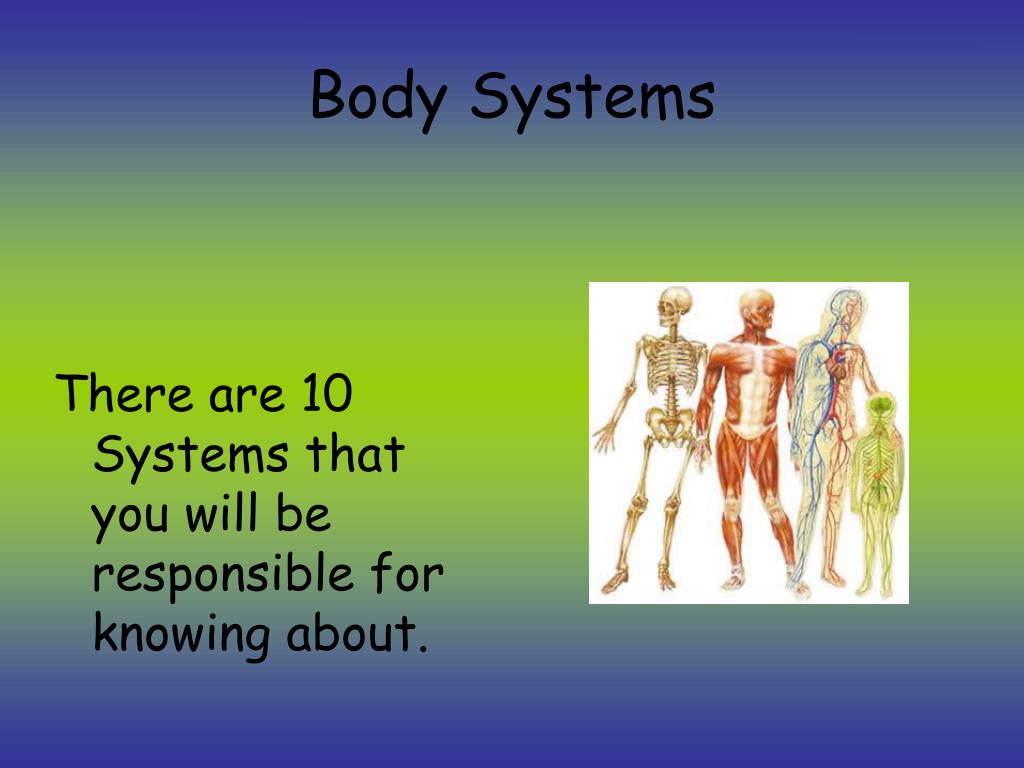
Body Systems. There are 10 Systems that you will be responsible for knowing about. Function/s:. gives structural support protects provides shape stores minerals produces red and white blood cells. Skeletal System. Parts:.
Une image / un lien ci-dessous est fourni (tel quel) pour télécharger la présentation
Politique de téléchargement : le contenu du site vous est fourni TEL QUEL pour votre information et votre usage personnel ; il ne peut être vendu, concédé sous licence ni partagé sur d’autres sites sans l’accord de son auteur.Le contenu vous est fourni TEL QUEL, pour votre information et votre usage personnel uniquement.Téléchargez la présentation en cliquant sur ce lien.Lors du téléchargement, si vous ne parvenez pas à télécharger une présentation, l’éditeur a peut-être supprimé le fichier de son serveur.Pendant le téléchargement, si vous ne parvenez pas à obtenir une présentation, le fichier a peut-être été supprimé par l’éditeur.
F I N
Plus de contenu associé
Transcription de la présentation
Body Systems There are 10 Systems that you will be responsible for knowing about.
Function/s: • gives structural support • protects • provides shape • stores minerals • produces red and white blood cells • Skeletal System
Parts: • You Need to Know: skull, clavicle, ribs, vertebrae, pelvis, carpal, phalanges, patella, tarsals, metatarsals, fibula, tibia, femur, ulna, radius, elbow, humerus, scapula, mandible
Interactions: Circulatory System Marrow inside of your bones helps produce the cells inside of you blood.
Interactions: Muscular System Muscles connect to your skeleton They contract and move the skeleton along. Your skeletal system is made up of cartilage and calcified bone that work together. They help the process of movement happen in a smoother manner.
General Info:Genetic Conditions • Some genetic diseases cause individuals to grow excessive large and thick bones. • Other genetic diseases can cause bones to become brittle and break easily, while the collagen of the body does not have the strength of a healthy individual. • Even older people who break their bones can grow new bone and connective tissue that returns the bone to a usable state.
How does the muscular system interact with the skeletal system? Muscles connect to your skeleton They contract and move the skeleton along. Your skeletal system is made up of cartilage and calcified bone that work together. They help the process of movement happen in a smoother manner.
Gliding Joint Permits a wide range of mostly sideways movements - as well as movements in one direction
Interactions: Nervous System Even though thinking is not always involved in moving, the neurons of the nervous system are connected to most of the cells in your muscular system.
Digestive System You have smooth muscles that line your digestive system and help move food through your intestines.
Health: Keys to Maintaining Healthy Muscles: Endurance and Strength • http://www.nytimes.com/2008/05/13/health/13muscles.html • http://www.nlm.nih.gov/medlineplus/bonesjointsandmuscles.html To maintain endurance, you should engage in activities that pump blood to the muscles, like walking. For strength, you need to lift weights, concentrating on muscles of the back, legs, and arms.
General Info: Muscles called extensors cause your limbs to straighten. The triceps are extensors. Muscles called flexors force your joints to bend. A bicep is a flexor • http://www.biology4kids.com/files/systems_muscular.html • http://kidshealth.org/kid/htbw/muscles.html • http://science.howstuffworks.com/environmental/life/human- biology/muscle1.htm • http://www.youtube.com/watch?v=T-ozRNVhGVg
Function/s: • reduces water loss, • contains receptors that respond to touch, • regulates body temperature, and • protects the inside of the body from damage.