Download
1 / 7
70 likes | 222 Vues
This section explores the algebraic properties of vectors, highlighting their geometric aspects. It covers essential concepts, including the representation of points and vectors, unit vectors, and vector operations such as addition, subtraction, and scalar multiplication. The text illustrates how to derive parametric equations from points, emphasizing the direction vector and various forms of vector representation. Example problems help solidify understanding of concepts like component form, polar form, and equations of lines. Homework exercises are provided for practice.

E N D
In 12-7, we focused on the geometric aspect of vectors. 12-8 focuses on the algebraic properties. (x, y) Note: the book will use ( , ) for a point and a vector! Be careful! We will use , y x is the norm/ magnitude Unitvector: vector with magnitude 1 is the unit vector w/ same direction as (horizontal) (vertical) Component Form: Polar Form:
We can determine a vector if we know its initial (x1, y1) and terminal points (x2, y2). Ex 1) Given v with initial point (2, 3) & terminal point (7, 9), determine: component form polar form unit vector in same direction as
Vector operations: vector sum: vector difference: scalar multiplication: Ex 2)
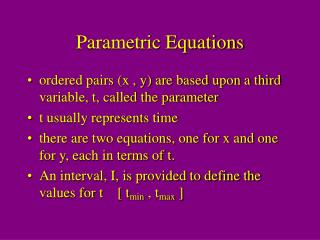
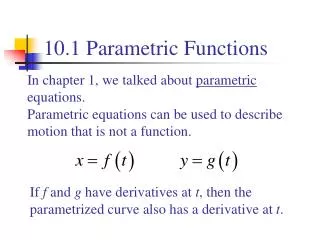
In this picture, Q(x, y) is a point and P(a, b) is a point. P(a, b) If you wanted to get to Q(x, y) from P(a, b), we could add a vector (x, y) = (a, b) + vector Since we don’t know the size of the vector, we can multiply by a scalar to get to the point. Q(x, y) , the direction vector will be given to you, or you can find it by subtracting the 2nd point – 1st point that they give you. so, (x, y) = (a, b) + tc, d (x, y) = (a, b) + tc, td (x, y) = (a + tc, b + td) this leads to x = a + tc and y = b + td these two eqtns are called parametricequations with parameter t of the line
Ex 3) Determine a direction vector of the line containing the two points P(5, 8) and Q(11, 2). Then find the equation of the line & a pair of parametric equations of the line. direction vector = Q – P = (11 – 5, 2 – 8) = 6, –6 vector equation of line: (x, y) = (5, 8) + t6, –6 parametric: x = 5 + 6t and y = 8 – 6t We can also represent other graphs (not just lines) in parametric. Ex 4) Graph the curve with parametric equations x = 3cost and y = 5sint. Find an equation of the curve that contains no other variables but x & y. square Ellipse put together 1
Homework #1208 Pg 651 #1, 3, 6, 9, 11, 15–18, 20, 21, 24, 29, 31, 33, 35