Your Electrical Heart
This resource delves into the critical objectives of EKG interpretation, focusing on identifying and understanding patterns in EKG graphs. It explains the electrical and mechanical functions of a normal heart rhythm, alongside key components like the SA node, AV node, and Purkinje fibers. Learn the importance of EKGs for diagnosing heart rhythm issues, as well as recognizing conditions like V-tach, V-fib, and asystole. Engage with practical exercises to analyze and interpret EKG strips, enhancing your comprehension of both normal and abnormal heart function.

Your Electrical Heart
E N D
Presentation Transcript
Your Electrical Heart Exploring EKG
Objectives • Find and interpret patterns on an EKG graph • Describe the electrical and mechanical components of a normal heart rhythm • Draw appropriate conclusions about the mechanics of various normal and abnormal heart functions based on EKG
Introduction • When have you heard the terms “V-tac”, “V-fib”, “asystole”? • What is an EKG or ECG? • What do you think a normal graph of the heart’s electrical activity looks like? (draw it) • Why do doctors and nurses need EKGs? Depiction of electrical activity in the heart Detect & diagnose problems with the patient’s heart rhythm
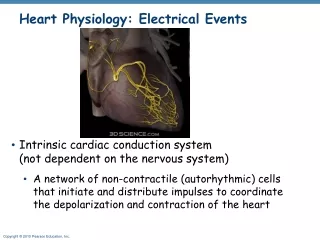
Review and new terms • Left & right atria: receive blood from the veins, pump it into ventricles • Left & right ventricles: receive blood from atria, pump it out into arteries • Sinoatrial (SA) node: bundle of nerves in R atrium, the heart’s pacemaker, stims contraction of atria • Atrioventricular (AV) node: between atria & ventricles, continues rhythm set by SA node, stims contraction of ventricles • Purkinje fibers: fan out and stimulate contraction of ventricles
Review: the cardiac cycle • How blood moves through the heart • Blood enters atria>>pressure in A rises>>AV valves open • Blood enters ventricles>>pressure in V rises>>AV valves close>>semilunar valves open>>blood leaves heart • Pressure in V falls>>S/L valves close
To Do and Notice • Look at your EKG strip. • Determine the patient’s heart rate in BPM if this is a 6 second rhythm strip. • Is the rhythm consistent? (describe) • How is your strip similar to a normal EKG? How is it different? • Based on what you know about the cardiac cycle, try to explain what is going wrong with this heart. • Present your patient to the class.
What’s Going On? • What terms and conditions do we learn from the EKGs?