Download
1 / 7
70 likes | 208 Vues
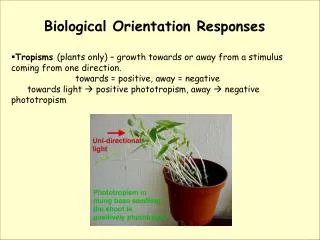
This article explores the fascinating ways plants respond to environmental stimuli, focusing on tropisms and nastic movements. Tropisms, such as phototropism and geotropism, describe growth responses towards or away from specific directional stimuli like light and gravity. Nastic responses, in contrast, occur without a directional stimulus, responding to factors such as temperature and humidity. Additionally, we discuss the plant growth control system, which includes a sensing system and response mechanism, featuring various photoreceptors like phytochrome and chlorophyll that guide plant development.

E N D
Tropisms • A growth response towards or away from an environmental stimulus coming from one direction • A shoot growing towards the light is positively phototropic • A root growing towards gravity is positively geotropic. • Roots in soil grow away from copper pipes, we say these are negatively chemotropic.
Nastic Responses • The response of plants to diffuse stimuli that do not come from any particular direction, e.g. temperature, humidity and light that surround a plant. • E.g. the opening and closing of flowers to different light intensities. • Photonasty – a response to alterations in the light intensity. • Thermonasty – a response to changes in the temperature.
The Control of Plant Growth • Plants have a “guidance system” or mechanism designed to make sure they grow in a suitable manner. • This presupposes 3 things: • A sensing system • A response system • A mechanism connecting the 2.
The Light-Sensing System • Plants have at least 3 distinct photoreceptors. • Phytochrome– (blue green) that controls the development of plants and flowering. • Chlorophyll – (green) and other yellow substances called Carotenoids, that run photosynthesis. • Riboflavin (yellow) and Beta Carotene (orange)
The Light-Sensing System • Coleoptiles contain riboflavin and beta carotene. • When pieces of membrane from coleoptile cells were examined they had the same absorption spectrum, and the only chemical found in the membrane was flavin. • So it seems the light detector in phototropism is a membrane-bound flavin pigment system.