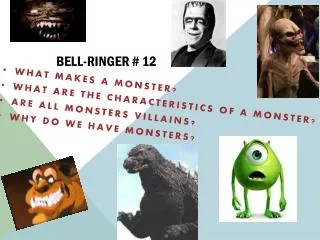
Bell-ringer # 12
This resource dives into the concept of monsters, exploring their characteristics, motivations, and the cultural significance behind their existence. Are all monsters villains, or do they serve different roles in stories? Additionally, the lesson covers vocabulary from the Middle Ages, providing definitions for terms like "eminent," "arbitrate," and "benign." Students are encouraged to incorporate these words into original sentences, deepening their understanding of the language in historical contexts. Engaging bell-ringer activities stimulate creative thinking and personal expression.

Bell-ringer # 12
E N D
Presentation Transcript
Bell-ringer # 12 What makes a monster? What are the characteristics of a monster? Are all monsters villains? Why do we have monsters?
Bell-ringer #13- Middle Ages Vocab • Copy down the following words and definitions. • eminent (adj): high-standing; great • arbitrate (verb): settle or decide by listening to both sides of an argument • benign (adj): kind; gracious; harmless; favorable • guile (noun): sly dealings; skill in deceiving • obstinate (adj): unreasonably stubborn • Please use each of the vocabulary words above in an original sentence.
Bellringer # 14 • What is cool about today???
Bell-ringer # 15 • Write a list of words that come to mind when you think of NOVEMBER Now, choose ONE of these words to write a short story (real or fiction)
Bell-ringer # 16: Middle ages vocab cont’d • A. Copy down the following words and definitions • frugal(adj): thrifty; careful with money • duress(noun): pressure or force to make somebody do something • hostelry(noun): inn • penitents(noun): people seeking the sacrament of confession so that their sins can be forgiven. (adj): expressing regret for having committed sins or misdeeds • motley(adj): multi-colored (noun): jester’s costume • Use each word in an original sentence; underline the word in the sentence.