
THE WEDGE
E N D
Presentation Transcript
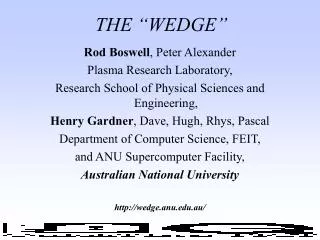
1. THE “WEDGE” Rod Boswell, Peter Alexander
Plasma Research Laboratory,
Research School of Physical Sciences and Engineering,
Henry Gardner, Dave, Hugh, Rhys, Pascal
Department of Computer Science, FEIT,
and ANU Supercomputer Facility,
Australian National University
http://wedge.anu.edu.au/
2. Limits of Vision of a human eye Total 15M pixels over the FOV of 4/3? (4) steradians, most dense in fovea.
Pixel resolution
28 seconds of arc - highest resolution
50 seconds of arc - "20/20" vision
1.5 arc - minutes - "20/30" acceptable vision
Normal 18" desktop computer at 24" and 1280 x 1024 resolution is at limit of resolution.
Small 48 cm. TV at 3 metres and 200 lines resolution can be improved by about a factor of two (eg. SVHS or Digital).
Each screen has resolution 1280 x 1024, image area 1.5 x 1.25 metres and viewed from about 1.5 metres yields a FOV of 0.8 steradians per screen.
Stand in 4th corner of WEDGE and the corners make 90 degrees, ie. about that of stereo vision, yielding a FOV of ?/2 ie. about 1.6 steradians. The display limit is about 20% of the eye limit.
3. Depth Clues from real world 1. Occlusion
2. Perspective projection
3. Binocular disparity
4. Motion Parallax
5. Convergence
6. Accommodation
7. Atmospheric
8. Lighting and Shadow
Workstation 1, 2, 7, 8 "VR" adds 3, 4 and 5
4. Virtual Reality (“virtual environments”) 3D (perspective) computer graphics in stereo
Interactivity
Mouse
6D Mouse
“Head tracking”
Robotic arms......
Human Computer Interface research (HCI)
High end: Silicon Graphics; supercomputing
Games end: PC cards; helmets; fun parlours
5. The first Wedge