The Transformation of America: Migration, Industrialization, and the Struggle for Rights (Chapters 13-14)
This overview examines significant changes in America during the 19th century, focusing on migration patterns, the impact of industrialization, and the struggles faced by Native Americans and African Americans. Key events, including the Gold Rush, the Indian Wars, and the establishment of the Populist Movement, highlight the complex interactions between settlers, indigenous people, and the growing demands of industry. The text further explores pivotal reforms and societal changes spurred by these transformative events, ultimately shaping the nation’s identity.

The Transformation of America: Migration, Industrialization, and the Struggle for Rights (Chapters 13-14)
E N D
Presentation Transcript
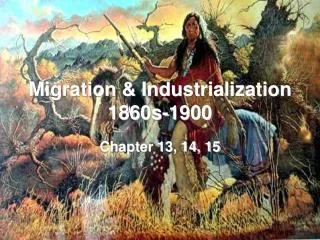
Migration and Industrialization Chpt 13-14 Pages 406-506
Chapter 13 Changes on Western Front • Native Americans and Culture on Great Plains • Believed land could not be owned • Discovery of Gold - Colorado – 1858 • 1850s changed policies/treaties over land
Treaty of Fort Laramie • Sioux Indians agreed to live on reservations along Missouri River • Sitting Bull was never signed treaty • Gold Rush – Black Hills Mts • Clash b/w Indians and Colonel George Custer • Summer 1876 Custer’s Last Stand • a.k.a Battle of Little Big Horn • Sitting Bull surrender 1881
Assimilation and Dawes Act (1887) aimed at “Americanize” Native Americans • Took Indian land and divided into allotments for individual Indians • Impact – ended communal holding of property, which ensured all Indians a home and a place in the tribe • Indian land depleted to 150 million acres to 78 million acres
What was really devastating for Indians? • Dying off of the Buffalo • Source of food, clothing, shelter, and fuel • 1890 less than 1000
Battle of Wounded Knee 1890 • Sioux Indians were suffering starvation/disease • Ghost Dance performed in hope of revival • Sitting Bull (leader) • Custer’s old regiment, rounded up 350 Indians took them to Wounded Knee Creek in S.D. • Unknown shot fired, soldiers opened fire • Within minutes, 300 Indians slaughtered • This “ended” Indians wars….
Cattle Becomes Big Business • After the War, beef huge demand, as more moved into the cities; along with growth of RR from Texas to Midwest • Map on page 415 • Cattle Trails
Legends of the West • Buffalo Bill’s Wild West Show • Wild Bill • Calamity Jane • Annie Oakley • Sitting Bull
Settling of Great Plains • RR open the West • Union Pacific moved West and Central Pacific moved East – yes, it was a race! • Homestead Act • 160 acres free land to any citizen • 600,000 families took this offer • Only 10% of intended land of settlement was used way it was intended (corruption/poor management, difference in land quality)
Morrill Act (1862, 1890) • Gave federal land to states to help finance agricultural colleges • 1862, Iowa State Ag College and Model Farm eventually renamed to ISU • 1890, created colleges and universities intended for African Americans
Populist Movement • Problems for Farmers • Crops failing • Mortgage farms manage debt • Land was becoming scarce • Couldn’t make payments on loans • High shipping prices on RR (grain)
Farmers’ Alliance – sympathizers • Membership 4 million • Populism – “People’s Party”, movement of the people • Reform! Lift the burden of debt from farmers and other workers, bigger voice in gov’t • What did they want? (page 427)
Chapter 14 Industrial Age • Transcontinental Railroad • Union Pacific moved West (blue) • Central Pacific moved East (red)
Chapter 15-16 • Ellis and Angel Island • Melting Pot • Myth many returned to home land within 5 yrs • Chinese Exclusion Act • Suspended immigration from China for 10 yrs – became permanent in 1902 (repealed 1943)
Civil Service Reform • Replaced Spoils System “reward system” • Pendleton Civil Service Act replaced reward system and now based on merit –qualifications because • President Garfield Assassinated by angry office job seeker in 1881
Wright Brothers - 1903 • Kitty Hawk, NC
Changes Every Day Life • Mass production • Montgomery Ward opened – 1st catalog with 150 items • Sears and Roebuck Co. • Campbell's Soup, Nabisco, Coca-Cola • Woolworth and “five and dime” stores • 1903 First World Series game – baseball • Modern Boxing endorsed by Teddy Roosevelt • NY Coney Island Amusement Park
Booker T. Washington • He believed blacks should concentrate on economic self improvement rather than social equality and civil rights • Tuskegee University 1882 • Agricultural and Vocational training school in Alabama • W. E. B. Du Bois • He believed education was key to equality and voting rights
Jim Crow Laws • Poll Tax & Grandfather Clause • Tax to vote • Literacy Tests • Grandfather – could only vote if their father or grandfather had voted in the past • Majority southern states made it extremely difficult for blacks to vote • Plessy v. Ferguson 1896 • Legal Segregation • “Separate by Equal” clause
Chpt 17-18 • Progressive Movement • Prohibition – booze was the evil of society • Supported by Protestant churches • 18th Amendment - 1920 • Repealed by 21st Amendment in 1933
Women’s Movement • Susan B Anthony • Suffrage and 19thAmendment effective in 1920
President McKinley assassinated in 1901 by anarchist V.P. Teddy Roosevelt took over at age 42 • Roosevelt’s “Square Deal” • Approach to social problems, big business, and labor union • He distinguished b/w “good” and “bad” • Preferred regulating BIG BUSINESSES
Regulating Food and Drugs • Meat Inspection Act • Pure Food & Drug Act • Conservation Reform • Avid hunter himself • Set aside millions of acres as national forest lands • NAACP
President Taft (Republican) • Bull Moose Party • Teddy returned hunting trip Africa • Progressive Party became known as Bull Moose Party – Roosevelt “as strong as a bull moose” • Split in Republican party • Wilson clear WINNER – Democrat in office
President Wilson (1912-1921) • Imperialism • Stronger nations extend their economic, political, or military control over weaker territories • Hawaii (1959) • Interest since 1840s • Sugar plantations • Permission naval base at Pearl Harbor 1887 • Territory in 1898
Age of Imperialism • Raw materials – need to feed the factories • European Markets, Hawaii, and South/Central America • Feelings of racial and cultural superiority
Spanish American War 1989-1899 • Out interest in Cuba-colony of Spain • Yellow Journalism • Writing style exaggerates news to LURE and enrage readers • Kinda like tabloids today • U.S.S. Maine • Letter leaked to press, insulting President McKinley “weak” • American resentment towards Spain increased
In response • McKinley ordered U.S.S. Maine to Cuba to bring home American citizens in danger • 1898 – ship blew up in Havana’s harbor • 260 men killed • Congress declares WAR in April
Fighting actually began in Philippines – other side of the world • George Dewey • Fired upon every Spanish fleet and was victorious within in hours • Filipinos wanted freedom from Spain just like Cubans and were willing to fights along side Americans
Back in Cuba • American forces landed in Santiago, Cuba – June of 1898 • Rough Riders – volunteer cavalry under command of Teddy Roosevelt along with African American regiments • San Juan Hill – famous battle Teddy famous but played a minor role • Treaty of Paris – ended war in Dec. 1898
Results of War • Spain freed Cuba • Guam and Puerto Rico to U.S. as territories • Sold Philippines also • Many Americans uncertain of our annexation of these territories and role of the U.S.
Philippines gateway to Asia and it’s markets • Open Door Policy – no single nation would have a monopoly on trade with any part of China • Boxer Rebellion – group against America’s role “foreign devils” • McKinley, Roosevelt, & Wilson continue to exert its power around the globe
President Teddy Roosevelt • 1901 after McKinley’s assassination • Panama Canal (began 1904) • Bought construction “process” from French company for $40 million • Colombia ruled Panama – fighting broke out • U.S. paid Panama $10 million plus annual rent $250,000 Canal Zone • Open in 1914
Roosevelt Corollary • U.S. would use force to protect its economic interest in Latin America – this comes after Monroe Doctrine (early 1800s) • President Wilson gave a moral twist to it – “missionary diplomacy”
Results – turn of the Century • Expanded access to foreign markets ensure growth • Built modern navy • Exercised international police power to ensure dominance in Latin America