Enhancing Sustainable Transportation Norms in Groningen Through Social Influence Strategies
This project explores the application of social norms theory to improve transportation behavior in Groningen. We investigate the effectiveness of injunctive and descriptive norms in promoting sustainable options like biking and public transit. Our field experiments address parking issues and aim to decrease car use by making norms salient through targeted messages. By aligning community behaviors with sustainable transportation norms, we expect to enhance public engagement and reduce environmental impact, positioning Groningen as a leader in sustainability.

Enhancing Sustainable Transportation Norms in Groningen Through Social Influence Strategies
E N D
Presentation Transcript
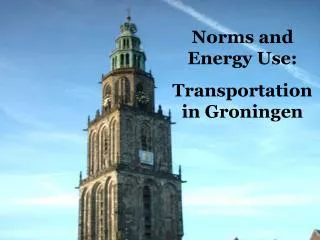
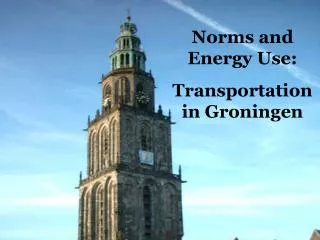
Norms and Energy Use: Transportation in Groningen
Social Norm Theory (Cialdini, Kalgren & Reno, 1990) Injunctive norms: The behavior commonly (dis)approved. (Social) Sanction, Reward Descriptive norms: The behavior commonly displayed. Salience is important Aligned norms are stronger mm-dd-yy | 2
Project 1 • Promoting Orderly Bike Parking in Groningen
Previous Studies on Parking Problems • 44% Sees inappropriate parking as a problem • 67% Shopping • 64% Park < 30 minutes • 42% Not enough parking spaces
Making the injunctive norm salient Prohibition sign: 37% Prescriptive sign: 60%
Making the injunctive norm salient • How? • Please park your bicycle within the green area
PROPOSED FIELD EXPERIMENT • Method: • Pre and post intervention • Observational • Outcome measures: • % Bikers conforming to parking norm • % Bikers being socially sanctioned
Car Public Transit Negative Env Impact Bike Walk Behavior
Social Norms • Theoretical gaps: • Behavior suggestions: 1 vs. 2 alternatives • Norm effectiveness: perception vs. actual
Action Research • 4 conditions (all groups receive information + incentive) • Bike norm info • Public transport norm info • Bike + PT norm info • Control
Action Research • Procedure • Telephone Survey • Mail packages • Outcome measures • Telephone follow up survey • Objective assessment
The message (For people 5-10 km) • Many people believe that using sustainable transportation is the right thing to do. (injunctive) • 53% of people in your neighborhood use a bike or public transportation to go to work everyday. (descriptive) • Join us in making Groningen the most sustainable city in the Netherlands! • Please use a bike or public transportation when you go to work.
Expected outcomes • Practical • Decrease car use in city for segmented area • Theoretical hypotheses • Experimental groups will reduce car use more than control • Perception of norm may interact with reported norm
“ Well, I think the tram is a good plan, as long as it will go past Euroborg” “I used the tram in Rio de Janeiro, Brussels, Amsterdam, and a couple of other city's. I really like it”
Which message works best? • Injunctive: “The tram will be an appropriate means of transportation” • Descriptive: 60% of people traveling within Groningen will take the tram When both norms align tram preference will increase
Which message works best… and for whom? • Target group: People working in Groningen and living outside of Groningen • Important: Identify with the individual providing the testimonial Vs. Identification with models will increase tram preference
Thank you for your attention mm-dd-yy | 23 K.E.Keizer@rug.nl