Advanced Techniques in High Energy Density Matter and Attophysics Research
70 likes | 207 Vues
This initiative focuses on the applications of high energy density matter within attophysics and high-intensity physics. Our team at the Laboratoire Francis Perrin provides comprehensive technical support, including mechanics, vacuum, and CAD for complex laser systems. With over 10 years of experience and state-of-the-art femtosecond laser technologies, we conduct research on excited biomolecules, chemical reactivity dynamics, and optimize laser synchronisation in collaboration with leading European institutions. Our advanced spectral and spatial interferometry techniques enable high-precision diagnostics and measurements.


Advanced Techniques in High Energy Density Matter and Attophysics Research
E N D
Presentation Transcript
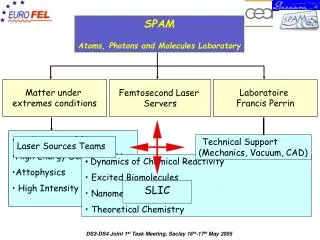
Applications of Plasmas • High Energy Density Matter • Attophysics • High Intensity Physics Technical Support (Mechanics, Vacuum, CAD) Laser Sources Teams • Dynamics of Chemical Reactivity • Excited Biomolecules • Nanometrics Buildings • Theoretical Chemistry SPAM Atoms, Photons and Molecules Laboratory Matter under extremes conditions Laboratoire Francis Perrin Femtosecond Laser Servers SLIC
SLIC Saclay Laser Interaction Center 10 years experience - 4 servers – 10 beamlines • LUCA, tunability from 10 to 800 nm SOFOCKLE : High repetition rate (KHz) UHI10: haute puissance de 10 TW • : High repetition rate Tunability Complementarity PLFA More than 90% for scientists CEA, France, Europe 60%, 20%, 20% Open Sources Reliability
SFM TypeI BBO crystal SHG TypeI BBO crystal Polarisers Prisms Half wave plate Neutral densities Input beam “Solar blind” PMT Interference filter R&D in laser femtosecond temporal diagnostics 3rd order Cross Correlator Optical scheme (colinear version) Sequoia is the first commercial high dynamic range third-order femtosecond cross-correlator, an ideal tool for high precision measurements of the temporal pulse shape of femtosecond lasers.
CEA/DS3 Financial and Work Plan • Synchronisation and Feedback: RF to Laser and Electron Beam • Participants: ELETTRA, CEA, CNRS (LOA, LULI, ELYSE), ENEA, INFN, MAX-Lab • Study the synchronisation issues between the master laser system, supplying the laser for the photo-injector, and another beam from the master laser system which could be used for seeding the first stage of a harmonic generation cascade, or for pump-probe user experiments at the different stages of the accelerator. • KHz tests on PLFA, studies on mechanical stability, amplifiers’ gain
PLFA (Tunable Femtosecond Laser Platform) 1 KHz, 20 mJ, 30 fs pulses JADE Compressor JADE (Gain x10) JADE (527 nm, 20 W) 4.7W JADE Ti:Sa 30 fs USERS JADE Multipass Amplifier 15 fs, 70 nm Regenerative Amplifier (Gain x105) Master Oscillator 2W POCKELS 6W dazzler l/2 POCKELS ph2 VERDI (532 nm, 4 W) 9W Ti Sa POCKELS 660mW ph1 TiSa POCKELS Preamplifier (Gain x3) Stretcher
CEA/DS3 Synchronization, Jitter and Drift Main Goal : Systematic Analysis How really large is the jitter in KHz laser systems ? • Averaged on different timescales • Pump Laser Stability • Mechanical stability (two amplified beams) • Air Flow dynamics • Non Linear effects in short pulse propagation • Shot to Shot • Pointing • Oscillator and Pump Laser Stability What about the drift ? • Thermal Stability
t t ’ CEA/DS3 Experimental Strategy Spectral Interferometry • High Accuracy (get sub-fringe information~2 fs) • No sensitivity to pointing fluctuations • Different spectra (no contrast reduction) • Analysis of different chirps (different fringe contrast) Spatial Interferometry • Portability • High Rate Acquisition with minor cost Single Shot Cross Correlator • Two amplified arms