Understanding Primitive and Centred Unit Cells in Crystallography
This content provides a comprehensive overview of primitive and centred unit cells in crystallography. You will learn to differentiate between unit cell types based on the positions of constituent particles. Primitive unit cells have particles only at the corners, while centred unit cells include additional particles at positions other than the corners. The course covers body-centred, face-centred, and end-centred unit cells, explaining their structures and significance in crystal lattices. Master these concepts to enhance your understanding of crystallography.

Understanding Primitive and Centred Unit Cells in Crystallography
E N D
Presentation Transcript
Learning Objectives After completing this content, you will able: • Understand the Primitive and Centred Unit Cells.
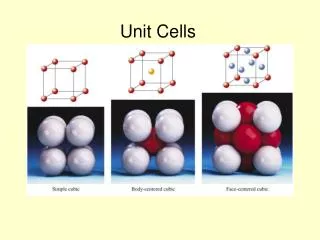
PrimitiveUnit Cells When constituent particles are present only on the corner positions of a unit cell, it is called as primitive unit cell.
Centred Unit Cells When a unit cell contains one or more constituent particles present at positions other than corners in addition to those at corners, it is called a centred unit cell.
Body-Centred Unit Cells A unit cell contains one constituent particle (atom, molecule or ion) at its body-centre besides the ones that are at its corners.
Face-Centred Unit Cells A unit cell contains one constituent particle present at the centre of each face, besides the ones that are at its corners.
End-Centred Unit Cells In such a unit cell, one constituent particle is present at the centre of any two opposite faces besides the ones present at its corners.