Understanding Atomic Structure and the Elements Essential for Life
This note provides a detailed overview of atomic structure, covering the six essential elements for living organisms, commonly referred to as CHNOPS (Carbon, Hydrogen, Nitrogen, Oxygen, Phosphorus, and Sulfur). It explains the components of atoms, including protons, neutrons, and electrons, as well as atomic number, mass number, and isotopes. The concepts of compounds, covalent and ionic bonding, mixtures, and solutions are also discussed, highlighting how atoms combine to form stable structures. This comprehensive guide serves as a foundation for understanding the basic building blocks of all matter.

Understanding Atomic Structure and the Elements Essential for Life
E N D
Presentation Transcript
Structure of An Atom Notes
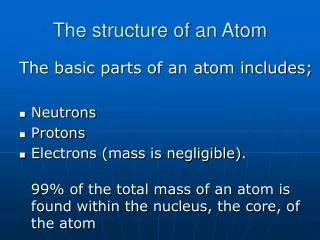
6 Elements that are needed for living things ____________ • ____________ = 96% of the Human Body CHNOPS CHNO
Atoms = ________________________ ________________________ = has all the characteristics of that element = ________________________ ________________________ smallest particle of an element basic building block of all matter
e- NUCLEUS e- e- e- e- e- e- ELECTRONS negative(e-) e- e- Electron cloud PROTONS positive (p+) Neutrons neutral (n°)
All nuclei are _________ because of the ________. • Each element has a different number of _________ positive protons protons
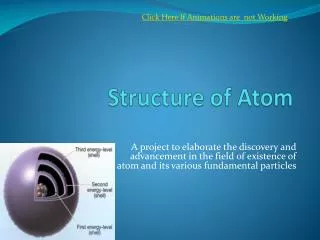
e- e- e- e- e- e- e- NUCLEUS e- Energy Levels Energy Levels e- e- 2 8 18
e- e- e- e- e- e- NUCLEUS e- e- Energy Levels Example: Oxygen = 8 e- 2 6
Atomic Number 8 15.9994 Atomic Weight • The # of p+ in nucleus • Determines which element an atom is O = the total # of particles an atom
8 15.9994 + = Number of n° Number of p+ MASS NUMBER Atomic Number O Atomic Weight then if you ROUND You will get the… Mass Number = the sum of p+ and n° Number of Neutrons = Mass # - Atomic #
8 15.9994 O What’s an isotope? So, why is this a decimal? It is an average of all the isotopes!
The Nuclei of 3 isotopes of H+ TRITIUM DEUTERIUM PROTIUM + + + 1 PROTON 1 PROTON 1 NEUTRON 1 PROTON 2 NEUTRONS Definition of isotope Atoms that have the same # of p+ but different # of n°
Substance with atoms of 2 or more elements that are chemically combined Compounds = • Example of Compounds: • H2O • CO2 • NaCl • C6H12O6 • HCl • NH4
e- e- e- e- e- e- e- NUCLEUS e- Atoms come together when the result is more ________ than the individual atoms stable If electron levels are filled to capacity then it is STABLE e- e- 2 8 18
How do they fill energy levels? • 1) BY SHARING ELECTRONS • 2) BY GAINING OR LOSING ELECTRONS
Method One: sharing electronsExample: Hydrogen e- H e- H H e- unstable sharing electrons is called "covalent bonding"
H H O Another example: H20 = water stable & happy!
Examples of Molecules with Covalent Bonding: • sugars, fats, proteins, & water • “MOLECULE” = group of atoms held together by a covalent bond
Method Two: gaining or losing electrons • An atom (or group of atoms) that gains or loses electrons = ION = (charged particle) If I gain an electron then I will become more negative If I lose a negative electron then I will become more positive
11 e- 11 p+ 17 e- 17 p+ Cl Na Na Cl + unstable unstable
stable Na Cl ionic bond Ionic bond = attractive force between 2 ions of opposite charge
MIXTURE Combination of substances in which the individual components retain their own properties Can be separated Ex: chex mix SOLUTION Mixture in which 1 or more substances (solutes) are distributed evenly in another substance (solvent) Ex: Jello Difference between a mixture & a solution