Download
1 / 11
110 likes | 238 Vues
This overview explores the mechanisms behind the movement of lithospheric plates, essential to the theory of plate tectonics. It highlights the significance of heat flow as a measure of thermal energy escaping from the lithosphere, particularly near spreading centers. As magma rises to create new oceanic crust, convection currents within the partially melted asthenosphere drive this movement. The concept of subduction boundaries is also discussed, showcasing deep-sea trenches formed when one plate plunges beneath another.

E N D
EVIDENCE FOR PLATE TECTONICS Why Do Lithospheric Plates Move?
Heat Flow and Seafloor Elevations • Heat flow is a measure of the amount of heat leaving the rocks of the lithosphere. • The values of heat flow are unusually high in the areas around spreading centers and decrease away from the centers. • This is exactly what should happen if spreading centers are places where hot convection currents are bringing magma to the surface forming new oceanic crust.
Convergent Boundaries: Subduction • A subduction boundary is a form of converging boundary where one plate plunges beneath another overriding plate. • A characteristic feature of a subduction plate is a deep-sea trench. The deepest places on the ocean floor are in such trenches.
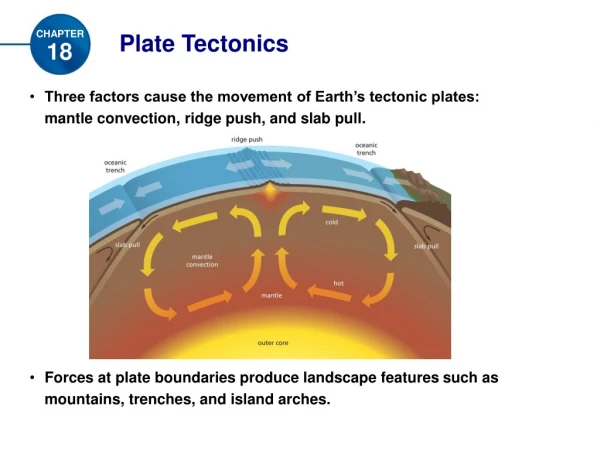
Why Do Lithospheric Plates Move? • Lithospheric plates rest upon the asthenosphere, which is a partially melted layer. • Convection currents within the asthenosphere are the driving force behind lithospheric plate movement. Within such currents, material expands and rises upon heating but contracts and sinks upon cooling. • Convection currents carry new material to the surface and pushes older material aside.