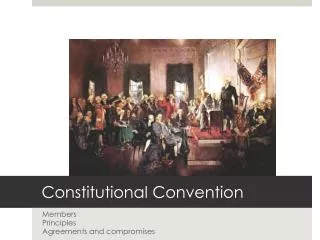
Constitutional Convention
The Constitutional Convention of 1787 prompted a fierce debate between proponents of the Virginia Plan, favoring a strong central government with proportional representation, and the New Jersey Plan, advocating for equal representation regardless of state size. Key compromises emerged, including the Connecticut Compromise, establishing a bicameral legislature. Federalists supported a robust national government, while Anti-Federalists emphasized state power and individual rights. This pivotal disagreement laid the foundation for the United States Constitution and the ongoing dialogue about federalism and representation in America.

Constitutional Convention
E N D
Presentation Transcript
Virginia v. New Jersey Plan Virginia Plan New Jersey Plan • James Madison • Strong Central Govt • 3 Branches- Executive, Judicial, Legislative • Legislative is most powerful • Legislature (Congress has 2 houses) • Proportional Representation in Congress • Reps equal to size of states’ population– Which states would like this???? • More similar to Articles of Confederation • Congress has only 1 house • Weak Central Govt • Equal representation in Congress- each state has same number of delegates no matter size– which states would like this??
Compromises • Connecticut- How should representatives be chosen? Proportional or equal? • House of Reps- proportional • Senate- equal • 3/5 Compromise- Which people should count in the population of each state? Just free people or free and slave? • Slaves count as 3/5 in terms of population
How strong should the federal government be? Federalists Anti-Federalists • Favored a strong central government • One of government’s prime functions was to maintain order • Wanted three branches and a two house legislature • Feared the masses getting too much power • What about problems like state money and taxes? • Favored a weak central government • Strong state governments • Wanted the government to be close to the people • State governments would be more sympathetic to the people than a large central government • Didn’t want to federal government to keep an army
Who is fit to rule? Anti-Federalists Federalists • Elitists • Saw themselves and those of their class as fit to govern (others were to be governed) • Believed that everyday people were not fit to rule • Had the support of property owners, rich merchants of Northeast and Middle Atlantic states • Believed in the decency of the common man and in participatory democracy • Wanted greater protection of individual rights ( a bill of rights!) • Had the support of many small farmers, shopkeepers, and laborers
How should the people be represented? Federalists Anti-Federalists • Virginia Plan • SUPPORTED THE CONSTITUTION AS WRITTEN • New Jersey Plan • Eventually OPPOSED ratification of the Constitution as we know it