Strategies for Identifying Unknown Words and Phrases in Text
This guide outlines effective strategies for identifying unknown or unclear words within a text. Techniques include looking for definitions within the sentence, using synonyms and antonyms for context, and considering explanations given in surrounding sentences. Practical examples illustrate how to apply these strategies, helping readers enhance their comprehension skills and vocabulary. Whether encountering literary works or everyday writing, these methods will empower readers to decipher unfamiliar language with confidence.

Strategies for Identifying Unknown Words and Phrases in Text
E N D
Presentation Transcript
CONTEXT CLUES Strategies to identify unknown or unclear words or phrases in a text.
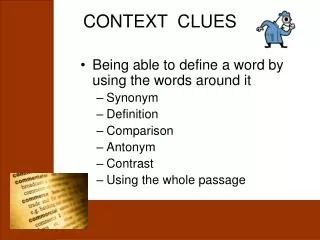
Definitions • Sometimes, the unknown word may be explained for you within the same sentence. • Emily Dickinson is said to have lived as a recluse, someone who is withdrawn from other people. • A joey, which is a baby kangaroo, peeked out of its mother’s pouch.
Synonyms • At times, an unknown word may be made clearer by finding a synonym for the word nearby. • Unfortunately, violence is a ubiquitous, global problem. • The dog was rebuked and scolded when it chewed the shelf.
Antonyms • An unknown word’s meaning may be inferred by noticing a word used an antonym near it. • Instead of being selfish by the end of the play, Mr. Scrooge became beneficent. • He was usually very talkative, but today was taciturn.
Explanation • The unfamiliar word may be explained within the sentence or sentences. • She thought that her accusing questions were causing a row. A row is a loud commotion or disagreement. • I will elicit the answer from you by giving you clues. To elicit is to draw out or bring out something from a person.
Example • Sometimes the unclear word may be seen in a sentence as a practical example. It will be possible to guess the word’s meaning based upon that example. • The couple became estranged after disagreeing too many times about how to use their money. • The spy moved imperceptibly through the shadows as she followed the criminal.