Download
1 / 38
380 likes | 500 Vues
This study examines the impact of riparian forest buffer restoration on water quality and aquatic ecosystems in the Chesapeake Bay watershed. By analyzing the relationship between buffer age, water quality, and benthic macroinvertebrate diversity, researchers provide valuable insights into the effectiveness of restoration efforts. Results indicate that older buffers contribute significantly to improved water quality and increased biodiversity among benthic communities. The findings highlight the importance of integrated management approaches for riparian zones and suggest future monitoring and management strategies for sustainable ecosystem health.

E N D
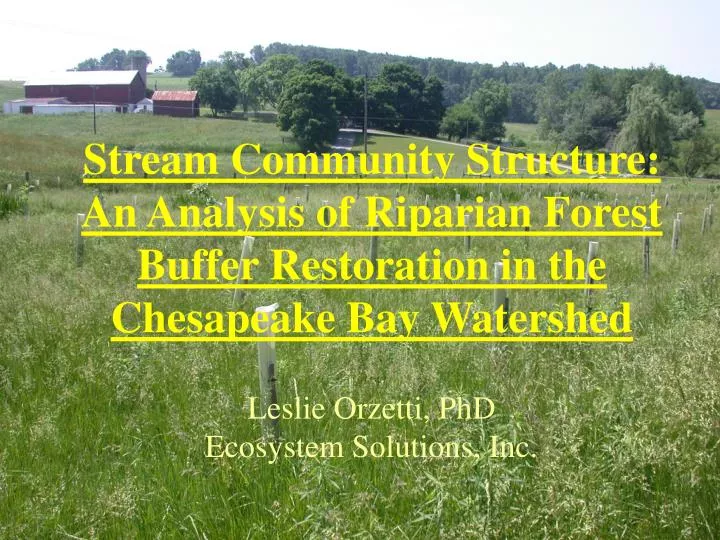
Stream Community Structure: An Analysis of Riparian Forest Buffer Restoration in the Chesapeake Bay Watershed Leslie Orzetti, PhD Ecosystem Solutions, Inc.
Outline • Background • Forest Buffer Zones • Benthic Macroinvertebrates • Chesapeake Bay • Hypotheses • Methods • Results • Discussion
What is a forest buffer? • Chesapeake Bay Program Definition • Areas of trees, shrubs and other vegetation, that are adjacent to a body of water, that are managed for several purposes
Benthic Macroinvertebrates: Nature’s Water Quality Indicators • What are they? • Why do we want to use bugs? • What affects them? • Water quality • Habitat • How do we use them? • Metrics
Hypotheses • Does stream water quality and habitat improve with relative age of restored forest buffer? • Does stream benthic community increase in diversity and richness with age of restored buffer? • Does stream benthic community diversity and richness increase with improved ambient water quality and habitat?
Sites • How big are they? • First order streams • Where are they? • Piedmont physiographic region • Frederick, Carroll, Loudon, Fauquier, Fairfax, Prince William Counties Okajangus, 1982
Sites with no buffer Wacopin Garrett
Sites 1-2 Years Old Stull Harbaugh
Sites 4-6 Years Old Royer Friend
Sites Older than 10 Years Monocacy NRMA Johnny Moore
Field Methods • 150 m reach in buffer zone • In situ water quality • DataSonde Hydrolab • Water samples • Benthic invertebrate collection • Habitat characterization • Landuse characterization
Laboratory Methods • Nutrient analysis • Nitrogen • Phosphorus • Solids analysis • Benthic invertebrate analysis • Identification • Metrics
Habitat Catharpin Popes Head
Conclusions • Habitat improved with age of buffer • Water quality improved with age of buffer • Benthic macroinvertebrate diversity and richness improved with age of buffer • Benthic macroinvertebrate diversity and richness improved with ambient water quality and habitat
Conclusions • Physical, chemical and biological components of a stream ecosystem are intrinsically linked • Younger buffered sites have the capacity to improve with time • Managers should see improvements within 5-10 years post restoration
Forest Buffers on DoD Installations • DoD Legacy funded study • Year 1 • Visited 15 field sites on 8 installations • Collected samples from 11 sites • Benthic macroinvertebrates • Water Quality • Habitat • 4 Sites unsampleable
Status of Buffers on DoD Installations • Several installations have well maintained restored buffer areas • Many installations have intact buffers without restoration • Natural Resource Manager turnover and loss of restored buffer information • Reporting of buffer miles
Recommendations and Future Considerations • In-stream improvements • Monitoring plantings • Continued stream monitoring (every 2-3 years post restoration) • Stream corridor preservation • Increase buffer zone width • Redefine forest riparian buffer zone for reporting restored buffer miles
Acknowledgements • George Mason University • Virginia Department of Forestry • Maryland Department of Forestry • Prince William Forest Park • Lab and Field Crews