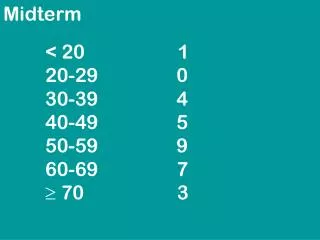

Midterm Winter 2002
E N D
Presentation Transcript
Midterm Winter 2002 Karl Lieberherr
COM 1205 • has just been renamed from • Software Design and Development to • Advanced Pattern Matching and Brain Exercise • motivation: • software development will change, but • your pattern matching skills will be useful for the rest of your lives
Three-way pattern matching • Our brains are good at matching patterns • Given two instances of a pattern, find the correspondences between the instances and the pattern • pattern = class dictionary • instance 1: sentence • instance 2: object
pointcut X1(S s1) : this(s); sentence AspectJFragment = <pointcuts> List(PointCut) EOF. PointCut = "pointcut" PCName <lhs> PCList(ArgDecl) ":" <rhs> PCExp ";". PCName = Ident. PCList(S) ~ "(" S { "," S } ")". List(S) ~ {S}. ArgDecl = <t> Type Variable. Type = Ident. Variable = Ident. class dictionary : AspectJFragment ( <pointcuts> : UNKNOWN-PARSE1 { <first> : Nonempty_PointCut_List ( <it> : UNKNOWN-PARSE2 ( <pcname> : UNKNOWN-PARSE3 ( <ident> : Ident "UNKNOWN-PARSE4" ) <lhs> : ArgDecl_PCList { <first> : Nonempty_ArgDecl_PCList ( <it> : UNKNOWN-PARSE5 ( <t> : UNKNOWN-PARSE6 ( <ident> : Ident "UNKNOWN-PARSE7" ) <variable> : UNKNOWN-PARSE8 ( <ident> : Ident "UNKNOWN-PARSE9" ) ) ) } object
pointcutX1(Ss1): this(s); sentence AspectJFragment = <pointcuts> List(PointCut) EOF. PointCut = "pointcut" PCName <lhs> PCList(ArgDecl) ":" <rhs> PCExp ";". PCName = Ident. PCList(S) ~ "(" S { "," S } ")". List(S) ~ {S}. ArgDecl = <t> TypeVariable. Type = Ident. Variable = Ident. class dictionary : AspectJFragment ( <pointcuts> : UNKNOWN-PARSE1 { <first> : Nonempty_PointCut_List ( <it> : UNKNOWN-PARSE2 ( <pcname> : UNKNOWN-PARSE3 ( <ident> : Ident "UNKNOWN-PARSE4" ) <lhs> : ArgDecl_PCList { <first> : Nonempty_ArgDecl_PCList ( <it> : UNKNOWN-PARSE5 ( <t> : UNKNOWN-PARSE6 ( <ident> : Ident "UNKNOWN-PARSE7" ) <variable> : UNKNOWN-PARSE8 ( <ident> : Ident "UNKNOWN-PARSE9" ) ) ) } establish correspondence object establish correspondence using colors
pointcutX1(Ss1): this(s); sentence AspectJFragment = <pointcuts> List(PointCut) EOF. PointCut = "pointcut" PCName <lhs> PCList(ArgDecl) ":" <rhs> PCExp ";". PCName = Ident. PCList(S) ~ "(" S { "," S } ")". List(S) ~ {S}. ArgDecl = <t> TypeVariable. Type = Ident. Variable = Ident. class dictionary : AspectJFragment ( <pointcuts> : UNKNOWN-PARSE1 { <first> : Nonempty_PointCut_List ( <it> : UNKNOWN-PARSE2 ( <pcname> : UNKNOWN-PARSE3 ( <ident> : Ident "UNKNOWN-PARSE4" ) <lhs> : ArgDecl_PCList { <first> : Nonempty_ArgDecl_PCList ( <it> : UNKNOWN-PARSE5 ( <t> : UNKNOWN-PARSE6 ( <ident> : Ident "UNKNOWN-PARSE7" ) <variable> : UNKNOWN-PARSE8 ( <ident> : Ident "UNKNOWN-PARSE9" ) ) ) } establish correspondence object
For phases 3 and 4: List Structure • List(X) first X_List NonEmpty_X_List next it X
pointcutUNKNOWN-PRINT1 (A UNKNOWN-PRINT2, B UNKNOWN-PRINT3, C c3): sentence PointCut = "pointcut" PCName <lhs> PCList(ArgDecl) ":" <rhs> PCExp ";". PCName = Ident. PCList(S) ~ "(" S { "," S } ")". ArgDecl = <t> Type Variable. Type = Ident. Variable = Ident. class dictionary <it> : PointCut ( <pcname> : PCName ( <ident> : Ident "X3" ) <lhs> : ArgDecl_PCList { <first> : Nonempty_ArgDecl_PCList ( <it> : ArgDecl ( <t> : Type ( <ident> : Ident "A" ) <variable> : Variable ( <ident> : Ident "a1" ) ) <next> : Nonempty_ArgDecl_PCList ( object
Two-way pattern matching • Given a pattern and and a use of it, find correspondences between pattern and usage. • pattern = method • usage = inlined code
Iterator it = used.iterator(); while (it.hasNext()){ Variable curvar = (Variable) it.next(); System.out.println(); curvar.print(); } java.util.Collection used void static UNKNOWN-ABS3 show(UNKNOWN-ABS4) { UNKNOWN-ABS5 while (it.hasNext()){ UNKNOWN-ABS6 System.out.println(); curvar.print(); } establish correspondence make method as general as possible! Who supports iterator()?
Two-way pattern matching • Given a pattern and and a use of it, find correspondences between pattern and usage. • pattern = a programming pattern • usage = an application in a specific context
AspectJFragment { {{ // method process finds all Compound-objects inside // an AspectJFragment-object and prints the message: // "This is a Compound expression: " // for each Compound-object. void process() { UNKNOWN-AP1; Main.cg.UNKNOWN-AP2(UNKNOWN-AP3, UNKNOWN-AP4, cV); } }} } CommandVisitor cV = new CommandVisitor(); this "from AspectJFragment to Compound" DJ programming pattern: class-graph.traverse(what, where-to-go, what-to-do) what = an object where-to-go = a traversal strategy what-to-do = a visitor
CommandVisitor { {{ // prints the message: // "This is a Compound expression: " // for each Compound-object. voidUNKNOWN-AP5(UNKNOWN-AP6){ System.out.println("This is a Compound expression: "); host.print(); System.out.println(); } }} } Compound host Selective visitor pattern: Visitor { {{ voidbefore(X host) { … use host … }; void after (X host) { … use host … }; }} } establish correspondence
AspectJFragment { {{ // Find all Variable-objects on the left-hand-side // (before the colon) of PointCut-objects static String definedVarsSpec = UNKNOWN-AP7 Answer: from AspectJFragment via PointCut via -> *,lhs,* to Variable"; Traversal strategy pattern: from A via X via Y to B AspectJFragment = <pointcuts> List(PointCut) EOF. PointCut = "pointcut" PCName <lhs> PCList(ArgDecl) ":" <rhs> PCExp ";". PCName = Ident. PCList(S) ~ "(" S { "," S } ")". List(S) ~ {S}. ArgDecl = <t> Type Variable. Type = Ident. Variable = Ident.