Exploring Past Tenses in French: Passé Composé vs Imparfait
This article delves into the nuances of French past tenses: the passé composé and the imparfait. We'll explore how these tenses are used to describe completed actions versus ongoing situations or habits in the past. Through examples, you'll see how to set the scene, provide background information, and convey emotions. Key phrases will illustrate how to narrate sequences of events, highlight changes, and describe habitual actions. By the end, you will have a clearer understanding of when to use each tense effectively in storytelling.

Exploring Past Tenses in French: Passé Composé vs Imparfait
E N D
Presentation Transcript
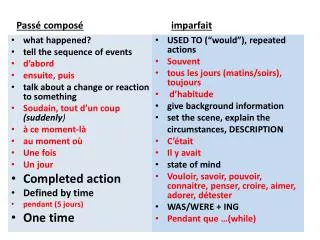
Passé composé imparfait USED TO (“would”), repeated actions Souvent tous les jours (matins/soirs), toujours d’habitude give background information set the scene, explain the circumstances, DESCRIPTION C’était Il y avait state of mind Vouloir, savoir, pouvoir, connaitre, penser, croire, aimer, adorer, détester WAS/WERE + ING Pendant que …(while) • what happened? • tell the sequence of events • d’abord • ensuite, puis • talk about a change or reaction to something • Soudain, tout d’un coup(suddenly) • à ce moment-là • au moment où • Une fois • Un jour • Completed action • Defined by time • pendant (5 jours) • One time
Tous les étés, quand nous étions jeunes, nous 1. avons passé/passionsnos vacances chez nos grands-parents. • Nous 2. Sommes arrivés/ arrivions toujours le premier août. • Mes grands-parents 3. ont habité/ habitaient au bord de la mer et il y 4.a eu/ avait une belle plage à côté de chez eux. • Un jour, je/j’ 5. suis allée/ allais faire une promenade tout seule. • D’abord je/J’ 6.ai pris/prenaisdes photos du paysage et puis je/j’ 7. suis descendue/descendaisjusqu’à la plage. • Il 8. a fait/ faisaitsi beau.
Tous les étés, quand nous étions jeunes, nous 1. avons passé/passionsnos vacances chez nos grands-parents. • Nous 2. Sommes arrivés/arrivionstoujours le premier août. • Mes grands-parents 3. ont habité/ habitaient au bord de la mer et il y 4.a eu/ avait une belle plage à côté de chez eux. • Un jour, je/j’ 5. suis allée/ allais faire une promenade tout seule. • D’abord je/J’ 6.ai pris/prenaisdes photos du paysage et puis je/j’ 7. suis descendue/descendaisjusqu’à la plage. • Il 8. a fait/ faisaitsi beau.