Download
1 / 1
10 likes | 130 Vues
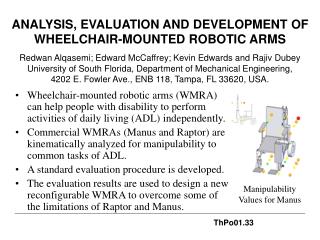
This paper discusses the analysis, evaluation, and development of wheelchair-mounted robotic arms (WMRAs) aimed at assisting individuals with disabilities in performing activities of daily living (ADLs) independently. A kinematic analysis of commercial WMRAs, such as Manus and Raptor, is conducted to assess their manipulability in common tasks. A standardized evaluation procedure is established, leading to the design of a new reconfigurable WMRA that addresses limitations found in existing models. The proposed design aims to improve user experience and functionality during ADL tasks.

E N D
ANALYSIS, EVALUATION AND DEVELOPMENT OF WHEELCHAIR-MOUNTED ROBOTIC ARMS Redwan Alqasemi; Edward McCaffrey; Kevin Edwards and Rajiv DubeyUniversity of South Florida, Department of Mechanical Engineering, 4202 E. Fowler Ave., ENB 118, Tampa, FL 33620, USA. • Wheelchair-mounted robotic arms (WMRA) can help people with disability to perform activities of daily living (ADL) independently. • Commercial WMRAs (Manus and Raptor) are kinematically analyzed for manipulability to common tasks of ADL. • A standard evaluation procedure is developed. • The evaluation results are used to design a new reconfigurable WMRA to overcome some of the limitations of Raptor and Manus. Manipulability Values for Manus ThPo01.33