The Muscular System
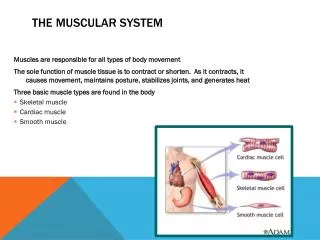
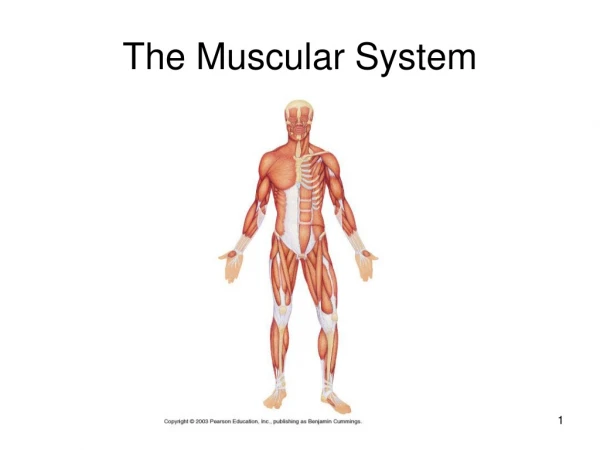
The Muscular System functions through intricate mechanics of skeletal muscle activity, where movement occurs as muscles pull on bones. Muscles attach at two points: the origin (immovable bone) and the insertion (movable bone). This guide covers essential types of body movements, including flexion, extension, rotation, abduction, adduction, and unique movements like dorsiflexion and pronation. Additionally, it outlines muscle classifications such as prime movers and antagonists while detailing muscle naming conventions based on size, shape, and location.

The Muscular System
E N D
Presentation Transcript
Muscles and Body Movements • Movement is attained due to a muscle moving an attached bone • Muscles are attached to at least two points • Origin • Attachment to an immovable bone • Insertion • Attachment to a moveable bone
Muscles and Body Movements Figure 6.12
Types of Ordinary Body Movements • Flexion • Decreases the angle of the joint • Brings two bones closer together • Typical of hinge joints like knee and elbow • Extension • Opposite of flexion • Increases angle between two bones
Types of Ordinary Body Movements Figure 6.13a
Types of Ordinary Body Movements Figure 6.13b
Types of Ordinary Body Movements • Rotation • Movement of a bone around its longitudinal axis • Common in ball-and-socket joints • Example is when you move atlas around the dens of axis (shake your head “no”)
Types of Ordinary Body Movements Figure 6.13c
Types of Ordinary Body Movements • Abduction • Movement of a limb away from the midline • Adduction • Opposite of abduction • Movement of a limb toward the midline
Types of Ordinary Body Movements Figure 6.13d
Types of Ordinary Body Movements • Circumduction • Combination of flexion, extension, abduction, and adduction • Common in ball-and-socket joints
Types of Ordinary Body Movements Figure 6.13d
Special Movements • Dorsiflexion • Lifting the foot so that the superior surface approaches the shin • Plantar flexion • Depressing the foot (pointing the toes)
Special Movements Figure 6.13e
Special Movements • Inversion • Turn sole of foot medially • Eversion • Turn sole of foot laterally
Special Movements Figure 6.13f
Special Movements • Supination • Forearm rotates laterally so palm faces anteriorly • Pronation • Forearm rotates medially so palm faces posteriorly
Special Movements Figure 6.13g
Special Movements • Opposition • Move thumb to touch the tips of other fingers on the same hand
Special Movements Figure 6.13h
Types of Muscles • Prime mover—muscle with the major responsibility for a certain movement • Antagonist—muscle that opposes or reverses a prime mover • Synergist—muscle that aids a prime mover in a movement and helps prevent rotation • Fixator—stabilizes the origin of a prime mover
Naming Skeletal Muscles • By direction of muscle fibers • Example: Rectus (straight) • By relative size of the muscle • Example: Maximus (largest)
Naming Skeletal Muscles • By location of the muscle • Example: Temporalis (temporal bone) • By number of origins • Example: Triceps (three heads)
Naming Skeletal Muscles • By location of the muscle’s origin and insertion • Example: Sterno (on the sternum) • By shape of the muscle • Example: Deltoid (triangular) • By action of the muscle • Example: Flexor and extensor (flexes or extends a bone)
Arrangement of Fascicles Figure 6.14
Head and Neck Muscles • Facial muscles • Frontalis—raises eyebrows • Orbicularis oculi—closes eyes, squints, blinks, winks • Orbicularis oris—closes mouth and protrudes the lips • Buccinator—flattens the cheek, chews • Zygomaticus—raises corners of the mouth • Chewing muscles • Masseter—closes the jaw and elevates mandible • Temporalis—synergist of the masseter, closes jaw
Head and Neck Muscles • Neck muscles • Platysma—pulls the corners of the mouth inferiorly • Sternocleidomastoid—flexes the neck, rotates the head
Head and Neck Muscles Figure 6.15
Muscles of Trunk, Shoulder, Arm • Anterior muscles • Pectoralis major—adducts and flexes the humerus • Intercostal muscles • External intercostals—raise rib cage during inhalation • Internal intercostals—depress the rib cage to move air out of the lungs when you exhale forcibly
Anterior Muscles of Trunk, Shoulder, Arm Figure 6.16a
Muscles of Trunk, Shoulder, Arm • Muscles of the abdominal girdle • Rectus abdominis—flexes vertebral column and compresses abdominal contents (defecation, childbirth, forced breathing) • External and internal obliques—flex vertebral column; rotate trunk and bend it laterally • Transversus abdominis—compresses abdominal contents
Anterior Muscles of Trunk, Shoulder, Arm Figure 6.16b
Muscles of Trunk, Shoulder, Arm • Posterior muscles • Trapezius—elevates, depresses, adducts, and stabilizes the scapula • Latissimus dorsi—extends and adducts the humerus • Erector spinae—back extension • Quadratus lumborum—flexes the spine laterally • Deltoid—arm abduction
Muscles of Posterior Neck, Trunk, Arm Figure 6.17a
Muscles of Posterior Neck, Trunk, Arm Figure 6.17b
Muscles of the Upper Limb • Biceps brachii—supinates forearm, flexes elbow • Brachialis—elbow flexion • Brachioradialis—weak muscle • Triceps brachii—elbow extension (antagonist to biceps brachii)
Anterior Muscles of Trunk, Shoulder, Arm Figure 6.16a
Muscles of Posterior Neck, Trunk, Arm Figure 6.17a
Muscles of the Lower Limb • Gluteus maximus—hip extension • Gluteus medius—hip abduction, steadies pelvis when walking • Iliopsoas—hip flexion, keeps the upper body from falling backward when standing erect • Adductor muscles—adduct the thighs
Muscles of the Pelvis, Hip, Thigh Figure 6.19a
Muscles of the Pelvis, Hip, Thigh Figure 6.19c
Muscles of the Lower Limb • Muscles causing movement at the knee joint • Hamstring group—thigh extension and knee flexion • Biceps femoris • Semimembranosus • Semitendinosus
Muscles of the Pelvis, Hip, Thigh Figure 6.19a
Muscles of the Lower Limb • Muscles causing movement at the knee joint • Sartorius—flexes the thigh • Quadriceps group—extends the knee • Rectus femoris • Vastus muscles (three)
Muscles of the Pelvis, Hip, Thigh Figure 6.19c
Muscles of the Lower Limb • Muscles causing movement at ankle and foot • Tibialis anterior—dorsiflexion and foot inversion • Extensor digitorum longus—toe extension and dorsiflexion of the foot • Fibularis muscles—plantar flexion, everts the foot • Soleus—plantar flexion
Muscles of the Lower Leg Figure 6.20a