SIGNIFICANT DIGITS
This resource covers the essential concepts of significant digits in measurements, highlighting the uncertainty inherent in all measurements taken using devices like stopwatches and balances. The rules for counting significant digits and the method for determining certainty in reported answers are explained. Additionally, it discusses magnification, including how it is expressed, its calculation between object and image dimensions, and an example problem illustrating the GRASP method for solving such questions.

SIGNIFICANT DIGITS
E N D
Presentation Transcript
Measurement and Calculated Answers • every measurement, taken from a measuring device such as a stopwatch, a balance, or a graduated cylinder has some uncertainty in it • the opposite of uncertainty in a measurement is certainty • the certainty of a measurement is expressed by the number of “certain” or significant digits
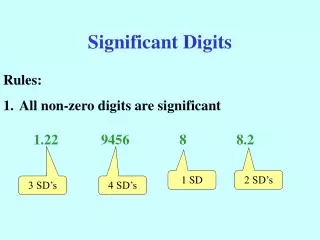
a measurement’s certainty is the number of certain digits obtained from the measuring device • rule for counting significant digits is: All digits included in a written measurement are significant except:(i) leading zeros (ii) trailing zeros to the left of the decimal point in measurements larger than one
example #1 For each of the following measurements state the number of significant digits. Measurement # of significant digits 5.2 m two 999 s three 0.125 cm three 450 m two 0.608 g three 3005 m four 0.0035 mL two
certainty rule for multiplying or dividing measurements: When multiplying and/or dividing, the answer has the same number of significant digits as the starting measurement with the fewest number of significant digits. example #2: What is the density of a liquid with a volume of 25 cm3 and a mass of 29.8 g? Express the answer to the correct degree of certainty. D = m/v = 29.8/ 25 = 1.192 = 1.2 g/ cm3
“SIG DIGS” PRACTICE • Complete all questions on p.89 in your course package
Magnification • Concave mirrors can be used to magnify objects • How much larger or smaller an image is compared to the actual object
Magnification • Expressed as a ratio of image height to object height, or image distance to object distance, e.g. OR
Magnification • Use the same units for both heights or both distances in the calculation • No units are required in the answer since the units cancel out • If the image is BIGGER than the object, the magnification will be GREATER THAN 1 • If the image is SMALLER than the object, the magnification will be LESS THAN 1
EXAMPLE PROBLEM • A microscope produces an image that is 5.50 x 10⁻⁴ m high from an object that is 2.00 x 10⁻⁶ m high. What is the magnification of this microscope?
“G.R.A.S.P” METHOD • G = Given • R = Required • A = Analyze (formula) • S = Substitute (numbers) and Solve • P = Paraphrase (sentence)
SOLUTION • Given: - Object height ho = 2.00 x 10⁻⁶ m • Image height hi = 5.50 x 10⁻⁴ m • Required: • Magnification, M = ? • Analysis:
SOLUTION • Substitute and Solve: M = 5.50 x 10⁻⁴ m = 275 • Paraphrase: - The magnification of the microscope is 275X 2.00 x 10-6 m