Aluminum Foil Thickness Investigation: Understanding Measurements and Significant Digits
In this hands-on investigation, students will work in groups to determine the thickness of a piece of aluminum foil using measurements of mass and volume. Employing the density of aluminum (2.70 g/cm³), students will apply the formula for density while also learning about accuracy, uncertainty, and significant digits in measurements. The activity emphasizes the importance of precise measurement techniques and calculations in scientific practices, fostering a foundational understanding of the International System of Units (SI) and the role of significant digits in reporting values.

Aluminum Foil Thickness Investigation: Understanding Measurements and Significant Digits
E N D
Presentation Transcript
Aluminum Foil Investigation • Your teacher will provide you with a hand out of an investigation in which you will be trying to determine the thickness of a piece of aluminum foil • You will get into groups of 2 to 3 and complete the investigation
Hints for Investigation • Does anyone need a few hints to get them started? • Then density of aluminum is 2.70 g/cm3 • The equation for density is • Is anyone still having trouble? • Here’s another hint:
Using Measurements In Science • In the previous activity you were forced to take several measurements such as length, volume, and mass • We take measurements like this every day of our lives and often take them for granted • In science we use a standard system of measurements called the International System of Units (SI units) so that everyone is using the same system
Measurement and Uncertainty • When you were doing your calculations in the previous activity how accurate where your answers? • How accurate did you measure the aluminum with your ruler? • When working in science you need to know how much you can depend on measurements • You need to know when something was just an approximation
Measurement and Uncertainty • An example: How many great lakes are there? • There are 5 great lakes • What about the amount of millilitres in 1 L? • Number of seconds in 1 minute? • These are numbers that you can count or that are true by definition (exact numbers) • Now think about the numbers you were using in the activity, were they exact numbers?
Measurements and Uncertainty • In this course you will be using equipment such as rulers, balances and other scales to measure • You will be calculating most of your results with a calculator • These pieces of equipment as well as your ability to use them will affect your ability to record and communicate measurements and calculations
Significant Digits, Certainty, and Measurements • All measurements involve uncertainty • You cannot measure anything with complete certainty • The last (farthest right) digit in any measurement is always an estimate • Significant digits: are the digits that you record when you measure something (include digits that you are certain about and a final uncertain digit that you estimated
Example • 4.28 g has three significant digits: • The first two digits (the 4 and the 2) are certain • The last digit (the 8) is an estimate and therefore it is uncertain • The value 4.3 has two significant digits • Which digits are certain and which are uncertain?
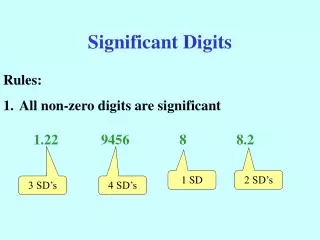
Rules for Determining Significant Digits • All non-zero numbers are significant Examples: • 7.886 has four significant digits • 19.4 has three significant digits • 527.266 992 has significant digits nine
Rules for Determining Significant Digits • Zeros placed between other digits are always significant. Examples: • 408 has three significant digits • 25 074 has significant digits • 7003 has how many significant digits? five
Rules for Determining Significant Digits • In a measurement with a decimal point, zeros placed before other digits are not significant. Examples: • 0.0907 has three significant digits. • 0.000 000 000 06 has . • 0.0056 has how many significant digits? one significant digit
Rules for Determining Significant Digits • Zeros that are located to the right of a value may or may not be significant • Zeros placed after nonzero digits after a decimal are significant Examples: • 9.100 has 4 significant digits • 802.0 hassignificant digits. • 7400.0 has how many significant digits? • If there is no decimal place then it becomes a bit more difficult to identify if the zeros to the right are significant 4
Rules for Determining Significant Digits • Zeros that are located to the right of a value may or may not be significant • If a decimal is not present, zeros to the right of the last non-zero digit are not significant. Examples: • 1200 has two significant digits • 520 has significant digits • 30 400 000 has how many significant digits? • What if you used a measuring tape to measure the length of a box and the length was exactly 200cm, how would you report this answer so that people know there are three significant digits? 2
Rules for Determining Significant Digits • Scientific notation is used to indicate whether zeroes at the end of a measurement are significant • Instead of reporting our length measurement as 200cm we would report it as 2.00xcm • When a measurement is written in scientific notation all digits in the coefficient are significant Examples: • has three significant digits • has significant digits • has how many significant digits? 5
Practice Problems (as a class) • Write the following quantities in your notebook. Beside each record the number of significant digits. • 24.7 kg • 247.7 mL • 247.701 mg • 0.247 01 L 3 significant digits 4 significant digits 6 significant digits 5 significant digits
Practice Problems (on your own) • Write the following quantities in your notebook. Beside each record the number of significant digits. • 8.9300x km • 2.5 g • 0.0003 mL • 923.2g 5 significant digits 2 significant digits 1 significant digits 4 significant digits
Homework!!! • Complete worksheet “How many significant digits for each number?” • Complete questions 1 and 2 on worksheet “Significant Digits and Rounding” BOOHOO!!!