Download
1 / 7
70 likes | 189 Vues
This article explores the differences between nations and states, highlighting that a nation is a group of people sharing a common culture, while a state (with a capital "S") is a self-governing political entity. The text details concepts like nation-states, which align cultural and political boundaries, and examines the characteristics of independent states, including sovereignty, recognition, and economic activity. Additionally, it discusses territories, their relationship with states, and examples like the U.S. territories. Gain insights into the global political landscape and the classification of regions.

E N D
Nations, States, and Territories • Are Nation and State the same thing? • No. Nation refers to a close group of people which share a common culture. • State (with the capital S) is a self-governing political entity. • Some States have two nations, such as Canada and Belgium. • A state with a small “s” is usually a division of a federal State (like Wisconsin being part of the U.S.)
Nation-State –political boundaries of the State match the cultural boundaries of the Nation. • The State has been around long enough that it has developed its own cultural character. • France, Egypt, Germany, and Japan = of nation-states. • Even with its multicultural society, the United States is also referred to as a nation-state because of the shared American "culture."
State (Independent countries) • 1) Space or territory which has internationally recognized boundaries (even if boundaries disputed). • 2) People who live there on an ongoing basis. • 3 ) Economic activity and an organized economy. • Regulates foreign and domestic trade and issues money. • 4) Has the power of social engineering, such as education.
5) transportation system for moving goods and people. • 6) government which provides public services and police power. • 7) Has sovereignty. No other State should have power over the country's territory. • 8) Has external recognition. A country has been "voted into the club" by other countries.
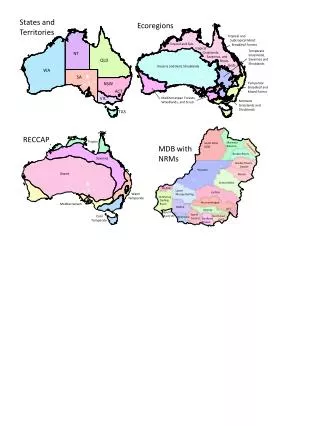
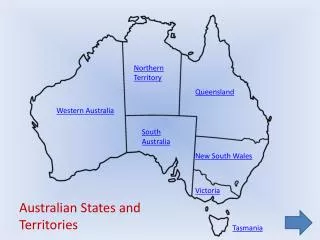
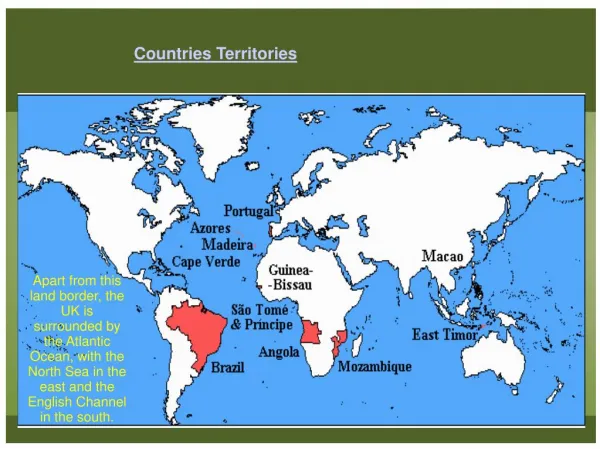
196 independent countries in the world. • Territories are parts of countries. They are NOT countries in their own right. • Over sixty additional territories are under the control of another independent country. • Some countries consider certain internal divisions to be territories • Canada -Northwest Territories, Nunavut, and Yukon Territory • Australia-Australian Capital Territory and Northern Territory). • Washington D.C. is not a state. • effectively a territory, but it is not external and not counted as a territory in America.
A territory will typically rely on its "mother country" for defense, police protection, courts, social services, economic controls and support, migration and import/export controls, etc. • Disputed or Occupied Territories • places where the jurisdiction of the place (which country owns the land) is not clear.
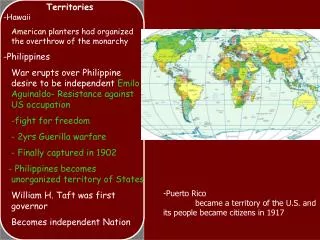
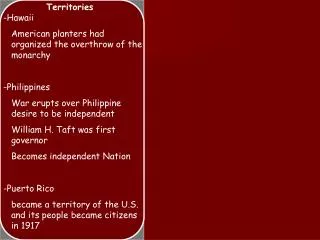
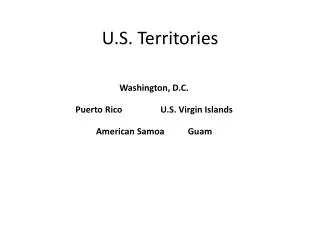
Territorial Powers • With fourteen territories, the United States has more territories than any other country. • American Samoa, Baker Island, Guam, Howland Island, Jarvis Island, Johnston Atoll, Kingman Reef, Midway Islands, Navassa Island, Northern Mariana Islands, Palmyra Atoll, Puerto Rico, U.S. Virgin Islands, and Wake Island. • The United Kingdom has twelve territories under its control.

![Our States and Territories: [ Name of Your State ]](https://cdn0.slideserve.com/1411642/our-states-and-territories-name-of-your-state-dt.jpg)