The Rise of American Imperialism: Events and Policies from Hawaii to Latin America
This overview explores key events and policies marking American imperialism from the late 19th to early 20th centuries. It highlights the overthrow of the Hawaiian monarchy, the Philippines War for independence, and the establishment of Puerto Rico as a U.S. territory. The text discusses U.S. interventions in Cuba, the Open Door Policy in China, and the construction of the Panama Canal under Roosevelt's Big Stick Foreign Policy. It elaborates on the moral implications of imperialism and America's emergence as a world power, alongside the impact of these actions on global relations.

The Rise of American Imperialism: Events and Policies from Hawaii to Latin America
E N D
Presentation Transcript
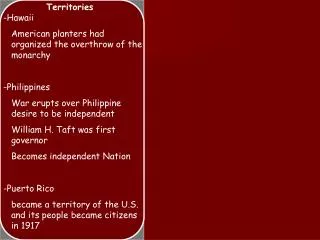
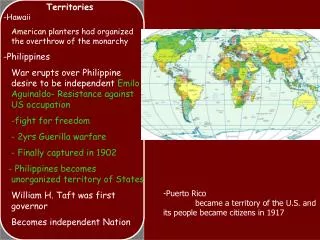
Territories -Hawaii American planters had organized the overthrow of the monarchy -Philippines War erupts over Philippine desire to be independent Emilo Aguinaldo- Resistance against US occupation -fight for freedom - 2yrs Guerilla warfare - Finally captured in 1902 - Philippines becomes unorganized territory of States William H. Taft was first governor Becomes independent Nation -Puerto Rico became a territory of the U.S. and its people became citizens in 1917 -Puerto Rico became a territory of the U.S. and its people became citizens in 1917
Cuban Intervention- after the war -Teller Amendment guaranteed Cuban Independence -Platt Amendment gives U.S. certain interests in Cuba 1. naval base 2. Limits on Cuban Gov’t 3. U.S. Intervention whenever the US believed it was necessary Protectorate Country: Affairs controlled by a stronger power
Asian Interests -US wanted to expand its Spheres of Influence in China (territories a nation exercises control over) Scared Europe’s imperial powers would try to gain control…. -Open Door Policy Notes John Hay Asked for access to China (Leave China open to trade w/US & rest of work) “Sick man of Europe” Chinese rebels Not happy about colonization of China- Sparked BOXER REBELLION -Russo-Japanese War Roosevelt is arbitrator Russo-Japanese War Roosevelt is arbitrator - a decisive victory from either side would dangerously tip the balance of power in the region -action showed an imperialist leader could occasionally become a PEACE maker in a conflict that was itself the product of imperialist rivalries
Panama Canal -Panama is part of Colombia -U.S. tries to negotiate a canal treaty -Colombia refuses -Panama has a revolution backed by the U.S. (US sent warships & urged Panama to rebel; Colombia DID NOT want to start a war with the US) -10 years of construction followed thousands died of accidents and disease to build the canal mosquitoes -Roosevelt’s Big Stick Foreign Policy -Roosevelt’s Big Stick Foreign Policy: Only the US would assume authority to Intervene in Hemispheric affairs as it saw fit
PG-572 Panama Canal -Panama is part of Colombia -U.S. tries to negotiate a canal treaty -Colombia refuses -Panama has a revolution backed by the U.S. -10 years of construction followed thousands died of accidents and disease to build the canal -Roosevelt’s Big Stick Foreign Policy PG-572
Foreign Policy -Monroe Doctrine basis of U.S. policy -.added on additions called-> 1.Roosevelt Corollary- -U.S. will be only nation to intervene (Big Stick Politics) -West African Proverb “Speak softly and carry a big stick” -2.Taft’s Dollar Diplomacy -U.S. will use financial policies to influence ($ not Bullets) - “Buying influence” -3. Wilson’s Missionary Diplomacy -U.S. refuses to negotiate with “illegal” gov’ts Promote democracy & moral progress
Impact of Imperialism -U.S. is now a world power -debate over the moral and ethical idea of imperialism -anti-U.S. feelings around the world Philippines Latin America Mexico Pancho Villa :: rebel, hated new Mexican Gov’t -US Backed new MX Gov’t - Pancho Villa Attacked boarding states of Mexico -US came close to war -Eventually put down but showed a clear model of AM. Imperialistic Attitudes of democracy & free enterpise through ARMED intervention -US came close to war -Eventually put down but showed a clear model of AM. Imperialistic Attitudes of democracy & free enterpise through ARMED intervention
Skim read 558-574 • Quiz # 37