Surface Water Equations
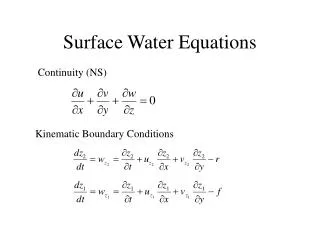
Surface Water Equations. Continuity (NS). Kinematic Boundary Conditions. Surface Water Equations. Integrate continuity equation over depth, term by term. Surface Water Equations. Third term… (need KW boundary conditions).

Surface Water Equations
E N D
Presentation Transcript
Surface Water Equations Continuity (NS) Kinematic Boundary Conditions
Surface Water Equations Integrate continuity equation over depth, term by term
Surface Water Equations Third term… (need KW boundary conditions) Regrouping, letting h = z2 - z1 with velocity constant with depth
Surface Water Equations Momentum (NS x-direction) Term-by-term integration First: Second:
Surface Water Equations Third: Fourth: need kinematic boundary conditions
Surface Water Equations Left side of momentum equation becomes:
Surface Water Equations In terms of shear stress, the right side is written Assume horizontal shear components are small
Surface Water Equations The first term is the unbalanced pressure force; when vertically averaged: (hydrostatic?)
Surface Water Equations The third term is the gravitational force:
Surface Water Equations The second term must be vertically integrated: Shear stress at the water surface is zero
Surface Water Equations Combining and multiplying by depth:
Surface Water Equations Combining all terms, the x-direction momentum equation for overland flow is Similarly, the y-direction equation is
Surface Water Equations With Some substitutions: p = hu , q = hv ql = r – f
Surface Water Equations The equations become:
Surface Water Equations Friction Slope terms: Darcy-Weisbach
Surface Water Equations Darcy-Weisbach continued… for laminar flow: So:
Surface Water Equations Mannings:
Surface Water Equations Vector (compact) notation:
Surface Water Equations Alternate Derivation: conservation of mass and momentum using Reynold’s Transport Theorem Continuity: Momentum:
Surface Water Equations 1-D St. Venant equations: conservation form local acceleration, convective acceleration, unbalanced pressure force, gravity force, and friction force
Surface Water Equations 1-D St. Venant Equations: non-conservation form
Surface Water Equations When can the kinematic wave approximation be used? • In general: • steep slopes • uniform flow • no backwater effects
Surface Water Equations For 1-D overland flow on a plane - kinematic wave number: and F0< 2 Woolhiser and Liggett (1967)
Surface Water Equations For 1-D plane or channel flow Hager and Hager (1985)
Surface Water Equations Wave Celerity (speed) Kinematic waves occur when there is a unique relationshhip between flow depth and discharge: general form: from Manning’s:
Surface Water Equations differentiate and sub into continuity the total derivative of discharge is or
Surface Water Equations from this we see that: discharge increases with lateral inflow and kinematic wave celerity
Surface Water Equations Is the KW celerity equal to mean velocity? - no. in a wide rectangular channel, u = Q/h, and substituting Manning’s equation:
Surface Water Equations Dynamic wave celerity