Mastering Vessel Maneuvering: Serpentine & Star Pattern Techniques
40 likes | 170 Vues
Enhance your boating skills with the Serpentine Course, focusing on relationship building with fixed objects while executing precise maneuvers to port and starboard. Familiarize yourself with your vessel's steering capabilities, throttle coordination, and ventilation prevention. Transition to slalom maneuvering, mastering the boat’s stern response during tight turns at cruising speed. Practice obstacle avoidance maneuvers and develop the essential skills needed for tight quarter maneuvers using the star pattern technique, ensuring you navigate safely amidst buoys.


Mastering Vessel Maneuvering: Serpentine & Star Pattern Techniques
E N D
Presentation Transcript
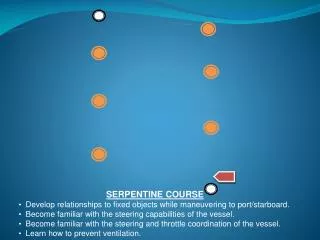
SERPENTINE COURSE Develop relationships to fixed objects while maneuvering to port/starboard. Become familiar with the steering capabilities of the vessel. Become familiar with the steering and throttle coordination of the vessel. Learn how to prevent ventilation.
TRANSITION to SLALOM MANEUVERING Learn how the boat stern responds to short turns of the wheel at cruising speed
PORT STARBOARD OBSTACLE AVOIDANCE MANEUVER Operations to simulate evasive maneuvers necessary to avoid a fixed object at cruising speed.
4 3 5 1 2 STAR PATTERN MANEUVERING • Skills necessary to maneuver a boat in tight quarters. • Boats enter between buoys 1 and 2, forward between buoys 3 and 4, reverse between buoys 1 and 5, forward between buoys 2 and 3, reverse between buoys 4 and 5, then forward & out of the pattern between buoys 1 and 2. On any maneuver, the boat’s centerline should not drift past the buoys. Consider wind and current before entering