Impact of Dietary Sodium on Diastolic Function Responsiveness to Angiotensin II
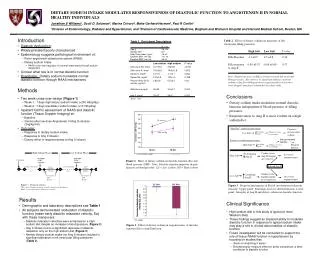
This study explores how dietary sodium affects diastolic function and blood pressure in healthy individuals. It shows that diastolic function improves despite increased blood pressure on a high-sodium diet. Mechanisms of RAAS involvement are proposed, highlighting the interplay of Angiotensin II and dietary sodium in diastolic function responsiveness.

Impact of Dietary Sodium on Diastolic Function Responsiveness to Angiotensin II
E N D
Presentation Transcript
DIETARY SODIUM INTAKE MODULATES RESPONSIVENESS OF DIASTOLIC FUNCTION TO ANGIOTENSIN II IN NORMAL HEALTHY INDIVIDUALS Jonathan S Williams1, Scott D. Solomon2, Marina Crivaro2, Marie Gerhard-Herman2, Paul R Conlin1 1Division of Endocrinology, Diabetes and Hypertension, and 2Division of Cardiovascular Medicine, Brigham and Women's Hospital and Harvard Medical School, Boston, MA Means ± SD Figure 2. Effect of dietary sodium on diastolic function (Ea) and blood pressure (SBP). Note: Diastolic function improves despite increase in blood pressure. LS = Low sodium; HS = High sodium Figure 3. Proposed mechanisms of RAAS involvement in diastolic function. Upper panel: Teleologic basis for altered function; Lower panel: Interplay of Ang II and dietary sodium on diastolic function Figure 3. Effect of dietary sodium on responsiveness of diastolic function (Ea) to Ang II infusion.