Understanding Acids and Bases: Properties, Calculations, and Equilibrium Expressions
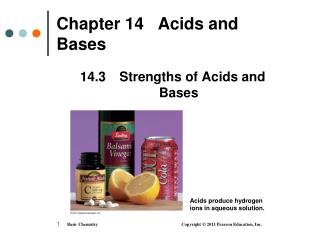
This chapter explores the fundamental concepts of acids and bases, defining acids as proton donors and bases as proton acceptors. It delves into the concepts of conjugate acids and bases, the acid dissociation constant (Ka), and the equilibrium expressions for acid-base reactions. You will learn to classify acids as strong or weak, understand the autoionization of water, and apply the pH and pOH scales in calculations. The chapter also covers the calculation of pH for strong and weak acids and bases, providing examples to illustrate these key concepts.

Understanding Acids and Bases: Properties, Calculations, and Equilibrium Expressions
E N D
Presentation Transcript
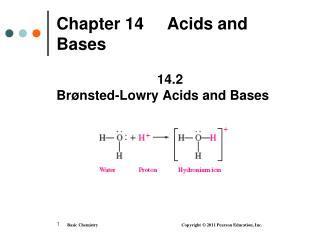
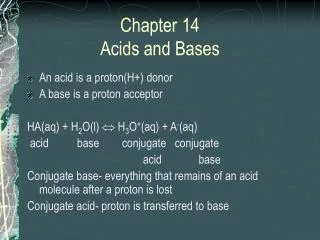
Chapter 14Acids and Bases • An acid is a proton(H+) donor • A base is a proton acceptor HA(aq) + H2O(l) H3O+(aq) + A-(aq) acid base conjugate conjugate acid base Conjugate base- everything that remains of an acid molecule after a proton is lost Conjugate acid- proton is transferred to base
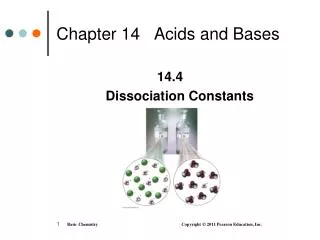
Acid dissociation constant What is the equilibrium expression for the general reaction? Ka= [H3O+] [A-]/[HA] or [H+] [A-]/[HA] Ka is called the acid dissociation constant
Acid Strength Strong acid- equilibrium lies far to the right Ka is large HCl, H2SO4, HNO4, HClO4 Weak acid- equilibrium lies far to the left Ka is small Phosphoric acid, Nitrous acid, Acetic acid
Water as an acid and a base • Amphoteric- acts as either an acid or a base • Autoionization of water-transfer of a proton from 1 H20 molecule to another to produce hydroxide ion and the hydronium ion H2O + H2O H3O+ + OH- or 2H20(l) H3O+ (aq) + OH-(aq) This leads to the Ion-product constant,Kw
Kw con. Kw= [H3O+] [OH-] or [H+] [OH-] At 25° C, [H+] = [OH-]= 1.0x10⁻⁷M Kw= (1.0x10⁻⁷) (1.0x10⁻⁷)= 1.0x10⁻¹⁴ At 25° C no matter what it contains, the product of [H+] and [OH-] 1.0x10⁻¹⁴
3 Possible situations • Neutral solution [H+] = [OH-] • Acid solution [H+] [OH-] • Basic solution [H+] [OH-] Calculate [H+] or [OH-] at 25°C. State if neutral, acidic, or basic. • 1.0x10⁻⁵M OH- • 1.0x10⁻⁷M OH- • 10.0 M H+
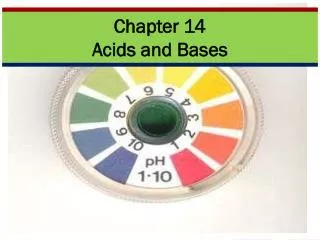
pH Scale pH= -log[H+] Example: [H+]=1.0x10⁻⁷M pH= 7.00 Other Log Scales pOH= -log[OH-] pK= -logK
Example14.5 Calculate pH and pOH for the following at 25°C. • 1.0x10⁻³ M OH • 1.0 M H+
Converting between p and concentration • pX= -log[X] (pH or pOH) = -log[H+ or OH-] • [X] = 10-pX [H+ or OH-] = 10-pX
Calculate “p” or [ ] of the following: • Calculate [Cl-] if pCl = 7.32 • Calculate pAg if [Ag+] = .034 M The pH of a sample of blood equals 7.41 at 25°C. Calculate the pOH, [H+], and [OH-]
Calculating pH of Strong Acid Solutions What are some examples of strong acids? HCl, HNO3, H2SO4, and HClO4 Calculate the pH and [OH-] of a 5 x10⁻³ M HClO4 solution. Calculate the pH of 1.0 x10⁻¹⁰ M HCl.
Calculating the pH of a Weak Acid Calculate the pH of a .100M aqueous solution of hypochlorous acid(HOCl) where Ka= 3.5x10⁻⁸. • List the major species. HOCl H2O
Con. • Write the balanced equations for the reactions producing H+. HOCl(aq) H+(aq) + OCl-(aq) H2O(l) H+(aq) + OH-(aq) • Compare equilibrium constants to determine the dominate H+ Ka= 3.5x10⁻⁸ Kw= 1.0x10⁻¹⁴
Con. • Write the equilibrium expression Ka= [H+] [OCl-]/ [HOCl] • Do an ICEbox
Con. • Substitute in Ka 3.5x10-8 = [x] [x] / [.100-x] 3.5x10-8 = x2/ .100 x= 5.9 x 10⁻⁵
Con. • Validate the approximation by 5% - compare x to [HA]0 x100% 5.95 x10⁻⁵/.100 x100= .059% • Calculate [H+] and pH [H+]= 5.95x10⁻⁵ M pH= -log[5.95x10⁻⁵] = 4.225
pH of a Weak Acid Mixtures • Calculate the pH of a solution that contains 1.00 M HCN(Ka=6.2x10⁻¹⁰) and 5.00 M HNO2 (Ka= 4.0x10⁻⁴). HCN(aq)H+(aq) + CN-(aq) Ka= 6.2x10⁻¹⁰ HNO2(aq) H+(aq) + NO2-(aq) Ka= 4.0 x10⁻⁴ H2O(l) H+(aq) + OH-(aq) Kw= 1.0x10⁻¹⁴
Con. Ka= [H+] [NO2-]/ [HNO2] HNO2 H+ NO2- I 5.00 0 0 C -x +x +x E 5.00 –x x x
Con. 4.0 x10-4 = [x] [x]/ 5.00-x approximate so 4.0 x10-4 = x2/5.00 X=4.5 x10⁻² Compare: 4.5 x10⁻² /5.00 x100 = .90% [H+]= 4.5 x10⁻² M pH= -log[4.5 x10⁻² ] = 1.35
Bases • Proton acceptors • Examples of strong bases: • NaOH, KOH, all groups in 1A&IIA